
Spring Preschool Lesson Plans (Free Weekly Activities + Printable Plan)
Goodbye winter, hello spring! If you’re planning your next theme and searching for spring preschool lesson plans, you probably want something that feels fresh, engaging, and easy to implement.
As the weather changes, preschoolers are full of energy and curiosity. They notice budding flowers, rainy days, baby animals, and longer afternoons. Spring is the perfect time to channel that excitement into thematic learning.
In this post, you’ll find a collection of free spring themed activities, organized by subject area and designed to support early literacy, math, science, art, and social development. Whether you teach at home or in a classroom, these ideas are developmentally appropriate, play-based, and simple to set up, and best of all…they are the perfect companion to your core preschool skills curriculum.
What You’ll Learn
- How to structure engaging spring preschool lesson plans for a full week
- Literacy, math, science, art, and movement activities ideas centered around spring themes
- Simple ways to teach spring concepts through play
- How to adapt activities for homeschool or classroom settings
- A sample weekly outline you can follow immediately
- Where to download a free printable spring lesson plan
Want All 46+ Preschool Themes Organized and Ready to Use?
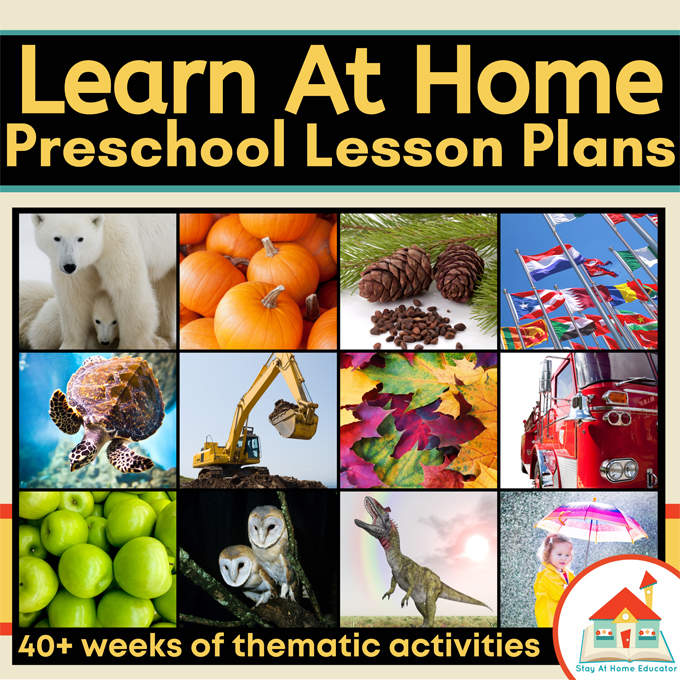
If you love these ideas but want also want all the themes (think 40+ preschool themes) the preschool themes bundle is for you! The Learn at Home Thematic Bundle activity ideas are already available free on the website, but this bundle puts them all into convenient, printable PDFs so planning each week is simple and streamlined.
Every week includes:
- Both literacy and math activities
- Science and nature activities
- Social-emotional activities
- “Playful learning” activities
Instead of searching and piecing everything together, you’ll have each theme ready to print and teach.
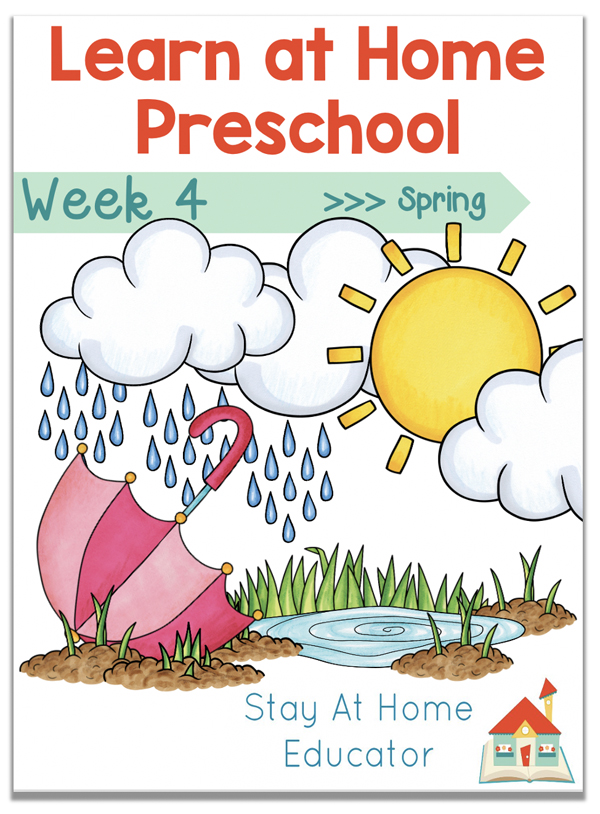
What to Include in Spring Preschool Lesson Plans
Strong spring preschool lesson plans typically include:
- A weekly theme focus (flowers, weather, insects, ponds, gardening, etc.)
- Literacy activities (letter work, name writing, storytelling)
- Math exploration (counting, measuring, sorting, graphing)
- Science investigation (plants, weather, life cycles)
- Art and sensory experiences
- Music and movement
These spring theme activity ideas give you simple, purposeful activities that actually make sense for this time of year. Nothing fluffy. Just meaningful literacy, hands-on math, fine motor practice, and routines that help your classroom feel calm and focused, even when the kids have spring energy.
It’s all about building skills in a way that feels natural and connected, so you can head into summer knowing you used this season well.
Spring Literacy Activities
Name Writing in Dirt or Sand – Write your child’s name on paper, then head outside to practice writing in dirt, mud, or sand using a stick. No outdoor space? Use a tray with a mixture of sand and soil and water for “mud writing.”
Spring Flowers Alphabet Matching – Match uppercase letters on flowerpots to lowercase letters on flowers. You can draw your own or use a printable version. This reinforces letter recognition and visual discrimination.
Spring Storytelling Prompts – Invite children to finish sentences like:
- “If I were a baby bunny…”
- “The rain cloud felt…”
- “When the seed woke up…”
Encourage drawing + dictation to support early writing skills.
Spring Math Activities
Flower Measurement Cards – Measure flowers (real or printable) using dried beans, cubes, or small objects. “This tulip is 12 beans tall!” This builds one-to-one correspondence and nonstandard measurement skills.
Seed Sorting – Sort seeds or dried beans by:
- Size
- Color
- Shape
- Texture
Add counting or simple graphing to extend learning.
Rainfall Counting Game – Draw clouds and place raindrop counters underneath. Roll a die and add that many raindrops.
Spring Science & Nature Activities
Spring Nature Walk – This one is simple! Go on a nature walk and look for:
- Budding leaves
- New grass
- Insects
- Birds building nests
Encourage observation and descriptive language, and go with the children’s conversations.
Flower Investigation – Bring flowers inside and allow children to gently explore petals, stems, and centers. Compare similarities and differences. Allow the children to dissect them, even.
Sunflower Growth Observation – Plant seeds in clear cups and track growth daily. Draw pictures of change, or mark their height on tape on the wall.

Spring Art & Sensory Activities
Rock Painting – Wash rocks and decorate with spring colors, flowers, or insects. Or, study rocks all week with out rocks preschool lesson plans.
Grassy Collage Art – Collect grass or leaves and glue onto paper to create textured spring art.
Salt Dough Flower Ornaments – Mix:
- 2 cups flour
- 1 cup salt
- 1 cup water
Knead, roll ¼ inch thick, cut into shapes, bake at 250° for 2 hours, then decorate.
Spring Music & Movement
Make Rain Sounds – Use fingers, clapping, and stomping to mimic rainfall. Experiment with loud and soft sounds. Try it to this Youtube video.
Flower Growing Movement Game – Start curled up like a seed. Slowly “grow” into a tall flower as music plays.
5 Little Flowers Growing in a Row – Add hand motions and encourage children to create their own actions.
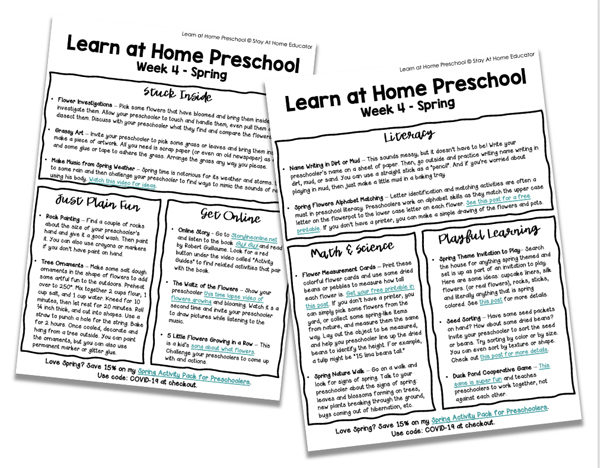
Sample Spring Preschool Weekly Plan
Here’s what a simple, but intentional, spring week can look like. This can also be adjusted for a month, where each week focuses on a spring sub-theme. The goal is not to pack in as much as possible. The goal is to build skills using thematic activities that support the core academic skills curriculum.
Monday – Flowers
Focus: Literacy + early math + fine motor
- Alphabet Matching: Match uppercase and lowercase letters on flower petals.
- Flower Measurement: Measure paper or real flowers with cubes or linking chains. Compare longer/shorter.
- Flower Art: Create labeled flower diagrams or paint spring flowers to strengthen hand control.
- Get a full week of Flower Themed Activity Plans.
Skills built: letter recognition, comparing length, vocabulary, pencil grip.
Tuesday – Weather
Focus: Listening + counting + comprehension
- Rain Sound Movement: Move like drizzle, wind, thunder and practice self-regulation.
- Rainfall Counting: Count raindrops with manipulatives or dot markers (1–10 or 1–20 depending on level).
- Spring Weather Read-Aloud: Discuss characters, setting, and weather vocabulary.
- See 16+ Weather Preschool Activity Plans.
Skills built: number sense, auditory discrimination, expressive language.
Wednesday – Seeds & Plants
Focus: Science + sorting + observation
- Seed Sorting: Sort by size, shape, or color. Introduce simple graphing.
- Plant Seeds in Cups: Hands-on planting with labeled names.
- Observation Journal: Draw and dictate what changes each day.
- Try these Nuts and Seeds Activity Plans.
Skills built: classification, sequencing, descriptive language, responsibility.
Thursday – Baby Animals
Focus: Oral language + gross motor + counting
- Storytelling Prompt: “A baby chick got lost…” (encourage problem-solving language).
- Animal Movement Game: Hop like a bunny, waddle like a duck — following multi-step directions.
- Counting with Animal Figures: One-to-one correspondence using small manipulatives.
Skills built: narrative skills, coordination, counting accuracy.
Friday – Nature Exploration
Focus: Observation + reflection + community
- Nature Walk: Look for signs of spring. Use simple checklists or picture cards.
- Drawing Observations: Sketch and label what was found.
- Cooperative Spring Game: Partner or small-group game that reinforces turn-taking and teamwork.
- Check out these Nature Themed Preschool Activity Plans.
Skills built: attention to detail, vocabulary expansion, social development.
How to Use These Spring Preschool Lesson Plans
These spring activities aren’t random crafts or filler ideas. They’re intentionally designed to support my preschool curriculum, by building literacy, math, fine motor strength, language development, and routines in a way that feels connected and developmentally appropriate.
Each activity reinforces core skills your preschooler actually needs, while still keeping learning playful and engaging.
For Homeschool
You don’t need to do everything.
- Choose 3–4 activities per day.
- Keep each lesson short, only about 10–15 minutes.
- Prioritize connection and conversation over completion.
Sit with your child. Talk about what they notice. Ask simple questions. Let them explain their thinking. The learning happens in those small exchanges just as much as in the activity itself.
Because these plans align with the curriculum, you can feel confident that even a short, focused morning is covering what matters.
For Classrooms
These plans work beautifully within a structured preschool setting.
- Use activities as literacy, math, or fine motor centers.
- Rotate small groups to allow for more individualized support.
- Repeat key activities throughout the week to strengthen skill retention.
You can easily differentiate by adjusting expectations, such as counting to 5 for some students, to 10 or 20 for others. Matching beginning sounds for one group, full letter recognition for another.
More Spring Theme Preschool Lesson Plans
If you’re planning multiple weeks, you might also love:
- Rainbow Preschool Lesson Plans
- Gardening Preschool Lesson Plans
- Seasons Preschool Lesson Plans
- Birds and Nests Preschool Lesson Plans
- Bees Preschool Lesson Plans
- Pond Preschool Lesson Plans
- Insect Preschool Lesson Plans
Each can extend your spring unit into a full month or longer.
Get Your Free Spring Preschool Activity Plans Printable
Ready to grab your free spring preschool lesson plans printable? Download the weekly outline and activity guide to make planning simple and organized.
The Learn at Home Thematic Bundle is a complete set of weekly preschool lesson plans built around fun, engaging themes that cover all the key learning domains you care about, including literacy, math, science, fine motor skills, and more.
Designed to work whether you’re teaching at home or in a classroom, this bundle gives you ready-to-use, low-prep activities that follow a structured progression so you can confidently support your child’s developmental growth without scrambling for ideas each day.
It’s all about meaningful, purposeful play built on a curriculum foundation, helping little learners stay excited and successful as they build important preschool skills.
FAQ About Spring Preschool Lesson Plans
The most popular spring preschool lesson plan themes include flowers, gardening, seeds and plant growth, weather and rain, rainbows, insects, ponds, and baby animals. These themes work well because they connect directly to what children see and experience outdoors during the spring season. Hands-on exploration, nature walks, and sensory play make these topics especially engaging for preschoolers.
To create spring preschool lesson plans, begin with a central theme such as flowers or weather and build activities around core learning areas. Strong preschool plans integrate literacy, early math, science exploration, art, movement, and social-emotional development. Activities should be short, interactive, and developmentally appropriate. The goal is to balance focused learning with play so children stay engaged while building foundational skills.
Yes, free spring preschool lesson plans are widely available and often include printable activities and weekly outlines. These plans typically cover literacy, math, science, and art using seasonal topics like insects, gardening, and weather. Some resources also offer bundled printable versions for convenience, allowing parents and teachers to download complete weekly plans in PDF format.
A spring preschool theme usually lasts one to two weeks, depending on children’s interest and classroom scheduling. Some educators choose to extend popular subtopics, such as gardening or insects, into their own dedicated weeks. Preschoolers benefit from repetition, so revisiting key activities throughout the season helps strengthen understanding and skill development.
Spring preschool lesson plans work very well in a homeschool setting because they rely on simple materials and real-life experiences. Activities such as planting seeds, observing weather changes, and creating seasonal art are easy to adapt at home. Homeschool families often adjust lesson length and pacing to match their child’s attention span and learning style.
Comprehensive preschool lesson plans, including spring themes, should incorporate early literacy, foundational math skills, science exploration, creative expression, social-emotional learning, and physical movement. Integrating multiple subject areas within a single theme helps preschoolers make meaningful connections and supports whole-child development.
Want the Complete Done-for-You Thematic Plan?
The Learn at Home Thematic Bundle gives you everything you need to plan meaningful preschool days with confidence and ease.
What’s Included & Why It Works
- Ready-to-use, theme-based weekly lesson plans
- Activities designed to support literacy, math, science, and fine motor development
- A clear progression so skills build over time, not in isolation
- Play-based activities that still connect to developmental goals
- Low-prep and easy to implement — perfect for busy families or classrooms
- Helps you stay consistent without scrambling for ideas each week
- Designed to support your overall preschool curriculum so learning feels connected and purposeful
How It Helps You
- Eliminates lesson planning stress
- Keeps learning intentional and meaningful
- Reinforces skills through repetition and routine
- Gives you a balanced mix of hands-on play, teacher-led instruction, and natural discovery
If you want preschool lesson planning that feels organized, doable, and aligned with real developmental targets, this bundle makes it simple.
Grab our Weekly Thematic Activity Plans
Engaging, hands-on themes that complement your math and literacy curriculum.

I’m Sarah, an educator turned stay-at-home-mama of five! I’m the owner and creator of Stay At Home Educator, a website about intentional teaching and purposeful learning in the early childhood years. I’ve taught a range of levels, from preschool to college and a little bit of everything in between. Right now my focus is teaching my children and running a preschool from my home. Credentials include: Bachelors in Art, Masters in Curriculum and Instruction.