
Preschool Math Curriculum: Scope, Sequence & Daily Lesson Plan Guide
You know early math matters. You want a solid preschool math curriculum that’s more than worksheets and random counting games. But figuring out what to teach, when to teach it, and how to keep it developmentally appropriate can quickly become confusing.
And because preschoolers develop at different speeds, it’s easy to wonder: Am I teaching the right skills? In the right order? Often enough? When math becomes a smorgasbord of activities, kids can miss foundational skills that make kindergarten math much easier.
But when you’re equipped with a clear scope and sequence, hands-on preschool math activities and a spiraled, systematic approach that builds skills gradually, you can teach math in a way that delivers real results while still being fun for kids.
What You’ll Learn
- The core math skills preschoolers should learn before kindergarten
- A practical daily lesson routine you can repeat all year
- How to teach math through play, talk, and hands-on tools
- Easy ways to differentiate for mixed ages and skill levels
- Unit ideas and math activities for preschoolers you can use immediately
- How to choose a preschool math curriculum that’s developmentally appropriate
A Done-for-You Preschool Math Curriculum
If you’re tired of piecing together random activities and hoping you’re not missing something, a done-for-you scope and sequence can be a huge relief. The Daily Lessons in Preschool Math Curriculum is designed as a complete plan. It’s organized, spiraled, and activity-based so you’re not constantly reinventing math time.

What Math Do Preschoolers Learn?
A strong preschool math curriculum covers more than counting. The goal is to build math understanding through repeated experiences with real objects, real language, and real problem-solving.
Below is the typical scope for preschool math, plus how it looks in everyday learning.
Number Sense (the #1 priority)
Number sense skills include:
- Counting with one-to-one correspondence (one object : one number word)
- Understanding “how many” (quantity)
- Recognizing numerals (eventually)
- Comparing groups (more/less, same, fewer)
Read this: How to Teach Number Sense in Preschool
What It Looks Like
- Comparing groups: Two piles of blocks are placed side by side. The child says, “This one has more,” after counting both groups.
- Counting with one-to-one correspondence: A child lines up 5 toy cars and touches each one while counting aloud, “1, 2, 3, 4, 5.”
- Understanding quantity: After counting 5 cars, the child answers, “There are 5 cars,” without recounting.
- Recognizing numerals: The child sees a card with the number 4 and collects four counting bears to match it.
Teaching Tip: The most important shift in early number sense is moving from saying numbers to understanding quantity. Always connect number words to physical objects first—have children touch, move, or line up items as they count. When they finish counting, pause and ask, “So how many are there?” That small moment builds real mathematical understanding instead of rote counting.
Shapes & Spatial Sense
Geometry, shapes and spacial sense looks like this in preschool:
- Identifying common 2D shapes
- Noticing attributes (sides, corners)
- Comparing shapes
- Spatial vocabulary (above, below, next to, between, under, over)
Read this: The Ultimate Guide to Teaching Shapes to Preschoolers
What It Looks Like
- Identifying shapes: A child finds a circle during a classroom shape hunt.
- Noticing attributes: The child says, “A triangle has three sides.”
- Comparing shapes: Two shapes are placed together, and the child explains, “This square has four sides, and this triangle has three.”
- Spatial vocabulary: During block play, the child places a cube under the bridge and says, “It’s under!”
Teaching Tip: When teaching shapes, focus on attributes instead of appearance. Rather than saying, “This looks like a triangle,” guide children to notice sides and corners. That simple shift, from recognition to description, helps children understand shapes deeply instead of memorizing pictures.
Measurement
Measuring skills in preschool looks like:
- Longer/shorter, taller/shorter
- Heavier/lighter
- Full/empty
- Measuring with non-standard units (blocks, paper clips, hands)
Read this: The Ultimate Guide to Teaching Measurement in Preschool
What It Looks Like
- Longer/shorter: Two ribbons are compared, and the child says, “This one is longer.”
- Heavier/lighter: Using a balance scale, the child observes which object tips the scale down.
- Full/empty: During water play, a child says, “This cup is full. This one is empty.”
- Non-standard measurement: The child measures a book with cubes and reports, “It’s 6 cubes long.”
Teaching Tip: Measurement at this age is about comparison, not precision. The key is helping children physically test and observe differences. Let them line objects up, hold items in their hands, or use the same measuring unit consistently. Concrete comparison builds far more understanding than abstract explanation.
Patterns, Positions, & Logical Thinking
Patterning skills in preschool include:
- Recognizing repeating patterns (AB, AAB, ABB)
- Creating patterns
- Sequencing
Read this: The Ultimate Guide to Teaching Positions and Patterns
What It Looks Like
- Recognizing patterns: The child looks at red-blue-red-blue and says, “Red comes next.”
- Creating patterns: Using beads, the child builds a yellow-green-yellow-green pattern.
- Sequencing: The child places picture cards in order: wake up → eat breakfast → go outside.
Teaching Tip: Patterns become meaningful when children can explain them. Instead of simply asking, “What comes next?” ask, “What is repeating?” or “How do you know?” Encouraging children to verbalize the pattern strengthens logical thinking and deepens understanding.
Graphing & Data
Graphing skills in preschool include:
- Sorting items
- Counting categories
- Interpreting simple picture graphs
Read this: The Ultimate Guide to Teaching Graphing in Preschool
What It Looks Like
- Sorting items: Children sort buttons by color into separate bowls.
- Counting categories: After sorting, a child counts 6 red buttons and 4 blue buttons.
- Reading a graph: Looking at a class favorite fruit graph, the child says, “More people like apples.”
Teaching Tip: Graphing becomes powerful when it connects to real choices children care about. Use authentic classroom data, like favorite snacks, pets, weather—, and consistently ask comparison questions like, “Which has more?” This keeps graphing meaningful instead of mechanical.
Early Addition & Subtraction
In preschool, early addition and subtraction skills can include:
- Combining groups (addition)
- Taking away (subtraction)
- Acting out story problems
Read this: Ultimate Guide to Teaching Addition and Subtraction to Preschoolers
What It Looks Like
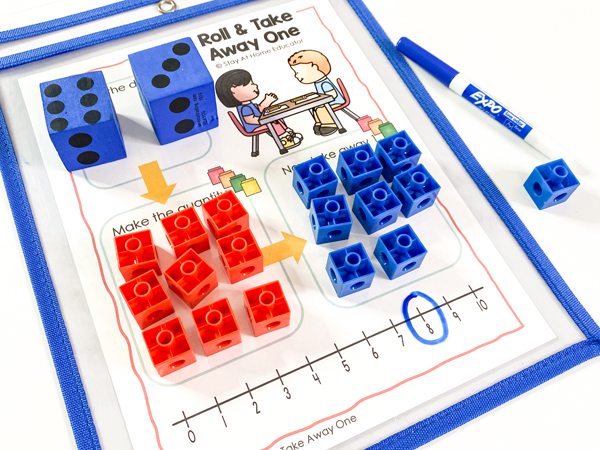
- Combining groups: A child joins 2 blocks and 1 block and counts, “1, 2, 3.”
- Taking away: The child starts with 4 bears, removes 1, and counts 3 left.
- Story problems: “Three frogs were on a log. One jumped off. How many are left?” The child models it with counters.
Teaching Tip: Keep addition and subtraction fully concrete at this stage. If children cannot physically move objects to show what happened, the concept is too abstract. Acting out story problems with manipulatives allows them to see math happen, which builds lasting understanding.
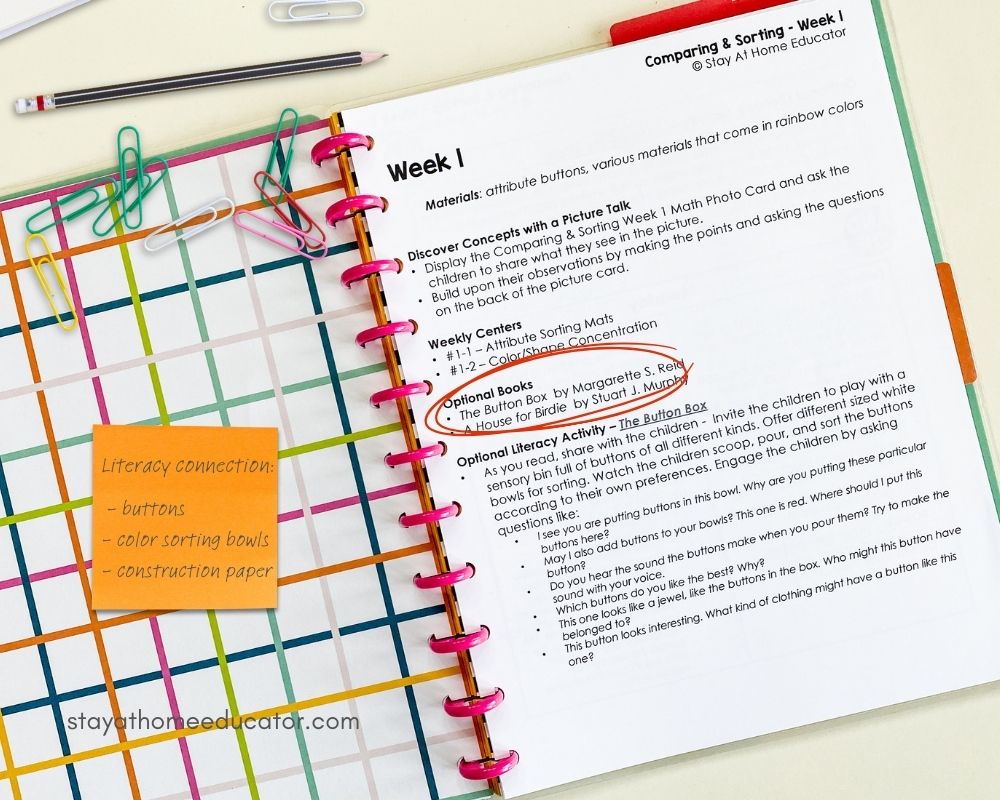
How to Structure a Preschool Math Curriculum (Daily + Yearly Plan)
Knowing the skills is only the first step. The real question is:
How do you organize all of that into a preschool math curriculum that actually works? A strong preschool math plan has two layers:
- A clear year-long scope and sequence
- A simple daily lesson structure
The Year-at-a-Glance Plan (Scope & Sequence)
A preschool math curriculum should move from concrete and simple toward more complex and abstract. This should be done gradually and intentionally. Here’s what that progression often looks like across a school year:
Beginning of the Year
- Sorting and classifying
- Comparing (more/less, same/different)
- Counting 0–5
- Introducing basic shapes
Mid-Year
- Counting 0–10
- Ten-frame familiarity
- Patterns (AB, AAB, ABC)
- Measurement comparisons
- Reading simple graphs
- Spatial language
At this stage, children are ready for slightly more complexity because they’ve had months of hands-on number experience.
Later in the Year
- Counting to 20
- Graphing and simple data analysis
- Early addition and subtraction (concrete only)
- Combining skills in multi-step activities
Why Sequence Matters
When math topics are taught randomly, children may learn pieces without connection.
A thoughtful preschool math curriculum introduces concepts in a purposeful order. Each new skill grows naturally from the one before it, giving children repeated opportunities to practice, apply, and deepen what they already know. Instead of jumping from activity to activity, learning becomes layered, and therefor concepts have more meaning to the children.
When skills are sequenced intentionally:

- Sorting supports graphing.
- Children first learn to group objects by color, size, or type. Later, those same sorting skills help them organize data into simple graphs and charts.
- Counting supports addition.
- Before children can combine groups, they need a strong understanding of one-to-one correspondence and number order. Confident counting makes early addition feel logical instead of confusing.
- Shape knowledge supports spatial reasoning.
- Recognizing and naming shapes lays the groundwork for understanding how objects fit together, rotate, and move in space.
- Comparison supports measurement.
- Before using rulers or standard units, children must understand concepts like more/less, longer/shorter, and heavier/lighter.
What a Daily Preschool Math Lesson Looks Like
Preschool math does not need to be long. In fact, shorter is better. A consistent 15–20 minute structure works beautifully.
1. Warm-Up (2–3 Minutes)
This might include:
- Counting together
- Reviewing yesterday’s concept
- A quick pattern chant
- A “number of the day” using objects
The purpose is activation, not mastery.
2. Mini-Lesson (5–7 Minutes)
This is where you introduce or model one idea using manipulatives. For example:
- Demonstrating how to line up objects before counting
- Showing how to compare two groups
- Building and describing a pattern
Keep it interactive. Ask questions. Let children touch and move materials.
3. Hands-On Practice (10–15 Minutes)
This is where real learning happens. Options include:
- Small group teacher-led activities
- Independent math centers
- Partner games
- Sorting trays, counting mats, ten frames
The key is repetition with variation. Children revisit the same skill in slightly different ways.
4. Quick Closure (1–2 Minutes)
End with one simple reflection:
- “What did we practice today?”
- “Show me a triangle.”
- “How many are there?”
That final moment strengthens retention.

Why Spiral Review Is Essential in a Preschool Math Curriculum
Preschoolers do not master skills after one lesson. They need repeated, spaced practice over time. A spiral math curriculum means:
- Skills are introduced.
- They are revisited weekly.
- They reappear in new formats.
- Complexity gradually increases.
For example:
- Children count to 5 in September.
- They count to 5 again while learning patterns.
- They count to 5 when measuring.
- They count to 5 when graphing.
- They count to 5 during addition stories.
The skill doesn’t disappear, rather it deepens. Without spiral review, children often “forget” concepts that seemed mastered. With it, understanding becomes automatic and confident.
Want to See a Real Week of Preschool Math?
It’s one thing to read about structure, but it’s another to see how it actually flows from day to day. Download a free sample from Daily Lessons in Preschool Math Curriculum and take a peek of what it looks like in real life.
Once you see how the structure works in a single week, it becomes much easier to understand how a full-year preschool math curriculum builds skills intentionally over time. Let’s take a closer look at how the complete program is organized, and what makes it different from piecing together random math activities.
What Makes a Strong Preschool Math Curriculum?
If you’re comparing programs, or creating your own, certain elements shouldn’t be optional. They should be core elements.
1. Clear Scope and Sequence
You need to see the roadmap. What skills are taught? In what order? And why does that order matter? Strong curricula lay concepts out in a logical progression so each new skill builds on the last.
2. Built-In Spiral Review
Preschoolers don’t master a concept after one short unit. They need to revisit it. A solid curriculum circles back to key skills again and again so understanding grows stronger over time.
3. Hands-On Before Paper
At this age, math should be something children can touch, move, and talk about. They learn through manipulatives, real objects, and guided conversation. Paper-and-pencil tasks can support learning, but they should follow hands-on activities, not replace it.
4. Short, Predictable Daily Structure
Long math blocks aren’t necessary. In fact, 15–20 focused minutes is often ideal. What matters more is consistency. When the format stays the same from day to day, children know what to expect. That predictability increases participation and minimizes behavior challenges.
5. Teacher Guidance
Lesson plans alone don’t make a curriculum. Teachers need clear language examples, modeling ideas, differentiation support, and help anticipating common misconceptions. Good guidance makes instruction intentional instead of reactive.
Preschool Math Curriculum Units (A Spiraled Scope & Sequence)
If you’re looking for a true preschool math curriculum, you need more than a list of skills. You need a plan that revisits those skills throughout the year, gradually increasing complexity.
The Daily Lessons in Preschool Mathematics curriculum follows a spiraling scope and sequence, meaning key concepts return again and again across 40 weeks, each time with deeper thinking and greater independence.
Instead of teaching one math strand in isolation and moving on, this structure interweaves algebra, number sense, geometry, measurement, and data analysis across the entire year. Here’s what that looks like:
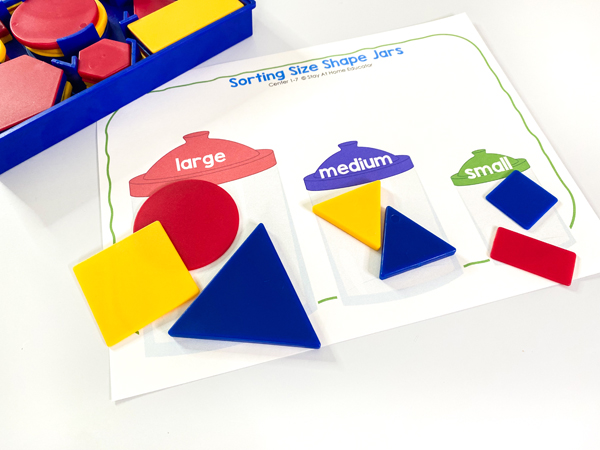
Unit 1: Comparing & Sorting (Algebra)
Children begin the year building foundational thinking skills through:
- Identifying similarities and differences
- Sorting by color, size, and shape
- Matching objects
- Classifying using self-created rules
- Explaining why items belong in a group
This unit introduces logical thinking — the earliest form of algebra.
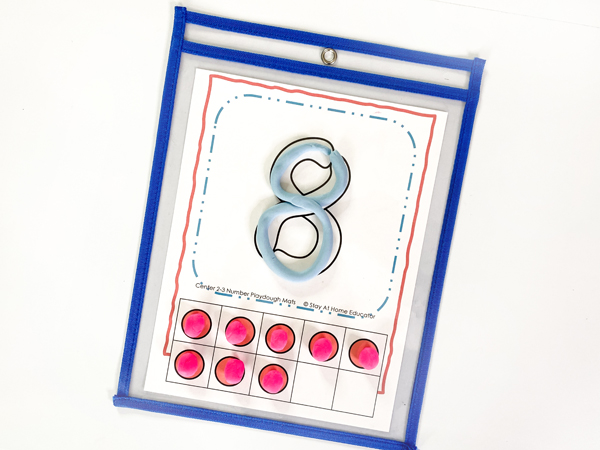
Unit 2: Counting 0–5 (Number Sense)
Children develop strong number foundations through:
- One-to-one correspondence
- Counting small sets accurately
- Understanding quantity (cardinality)
- Arranging objects in different formations while maintaining quantity
- Beginning numeral recognition
This unit repeats throughout early weeks to ensure deep understanding before moving forward.
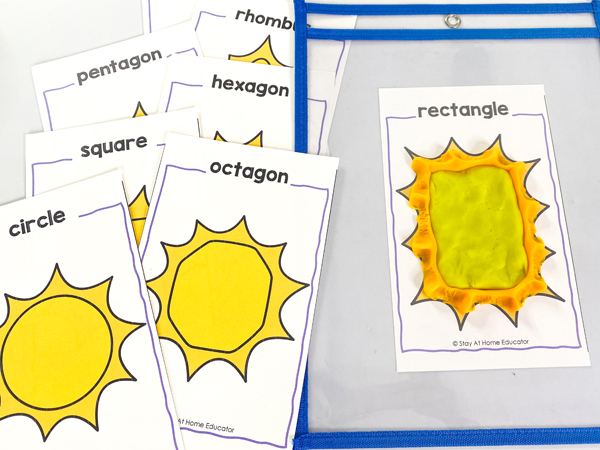
Unit 3: Shapes (Geometry)
Students explore:
- Identifying 2D shapes
- Noticing attributes (sides, corners)
- Comparing shapes
- Sorting shapes by attributes
- Describing shapes verbally
This unit appears multiple times across the year, each time increasing in complexity.
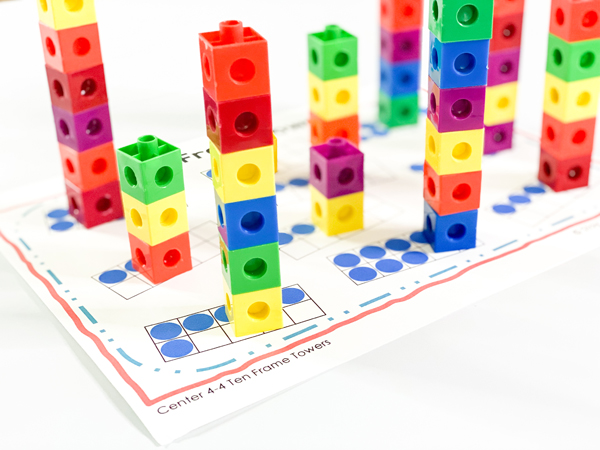
Unit 4: Counting 0–10 (Number Sense)
As number sense expands, children practice:
- Counting beyond five
- Using five-frames and ten-frames
- Comparing quantities
- Identifying numerals 0–10
- Understanding part–whole relationships
Counting 0–10 spirals throughout the middle of the year.
Unit 5: Positions & Patterns (Algebra)
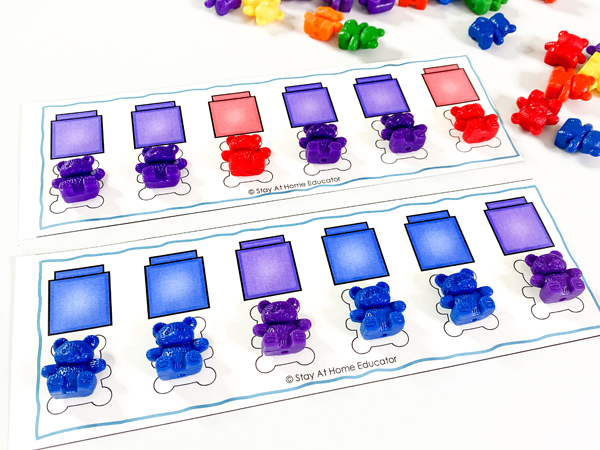
This algebra-focused unit builds:
- Recognizing repeating patterns (AB, AAB, ABB, ABC)
- Creating patterns
- Extending patterns
- Sequencing events
- Using spatial vocabulary (above, below, next to, between)
Patterns and position language strengthen logical reasoning and spatial awareness.
Unit 6: Measurement
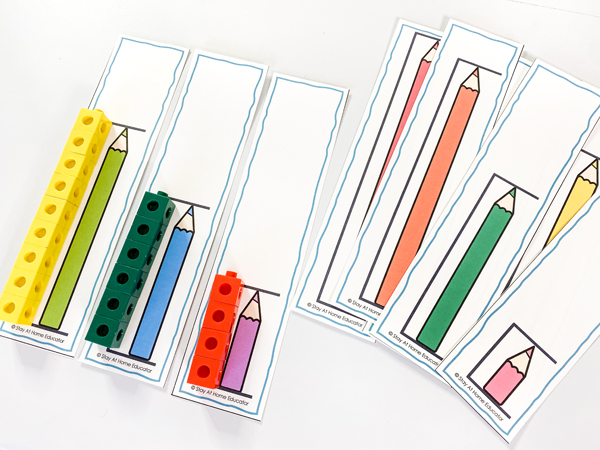
Across four spiraled rounds, children explore:
- Longer/shorter
- Taller/shorter
- Heavier/lighter
- Full/empty
- Measuring with non-standard units (blocks, cubes, hands)
- Comparing measurable attributes
Measurement builds directly on earlier comparison skills.
Unit 7: Graphing (Data Analysis)
Students apply sorting and counting to real data:
- Sorting items into categories
- Counting and comparing categories
- Interpreting picture graphs
- Discussing “more,” “less,” and “equal”
- Drawing simple conclusions from data
Graphing returns throughout the year to deepen understanding.

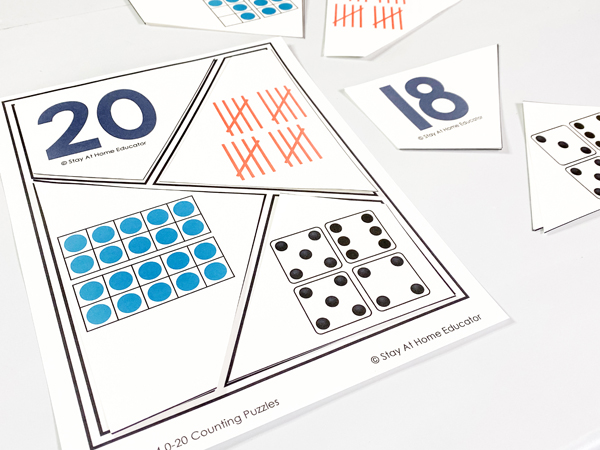
Unit 8: Counting 0–20 (Number Sense – Extended Unit)
This extended unit (6 weeks in the full curriculum) develops:
- Counting to 20
- Teen number understanding
- Double ten-frame work
- Comparing numbers within 20
- Reinforcing one-to-one correspondence
- Connecting numeral recognition with quantity
This unit intentionally appears multiple times to solidify fluency.
Unit 9: Addition & Subtraction (Number Sense – Extended Unit)
Also extended across six weeks, this unit introduces:
- Combining groups (addition)
- Taking away (subtraction)
- Acting out story problems
- Using manipulatives to model problems
- Understanding part–whole relationships
- Connecting addition to counting
All addition and subtraction instruction remains concrete and developmentally appropriate. No pencil and paper work, and no algorithm memorization.
Frequently Asked Questions About Preschool Math Curriculum
The best preschool math curriculum includes a clear scope and sequence, spiral review, and hands-on learning. It should cover number sense, shapes, measurement, patterns, graphing, and early addition and subtraction. Most importantly, it should be developmentally appropriate and structured in short daily lessons that preschoolers can manage successfully.
Preschool math works best when it is taught daily in short, consistent blocks. A 15–20 minute structured lesson combined with embedded math talk during play and routines is ideal. Frequent, short practice builds stronger understanding than occasional long lessons.
A spiral math curriculum introduces skills and then revisits them regularly throughout the year. Instead of teaching counting once and moving on, counting appears again during graphing, measurement, and addition lessons. This repeated exposure strengthens retention and deepens understanding over time.
Yes. Preschool math can be taught at home using simple materials like blocks, buttons, snacks, and toys. The key is consistency and structure. A clear scope and sequence helps ensure that important skills are introduced in a logical order and revisited often.
Children are ready for early addition and subtraction when they can confidently count small sets and understand quantity. In preschool, addition and subtraction should always be taught using real objects and story problems and never abstract equations.
Inside Daily Lessons in Preschool Math Curriculum
By this point, you know what a strong preschool math curriculum should include — a clear progression, spiral review, hands-on learning, and short daily lessons.
What makes Daily Lessons in Preschool Math Curriculum different is how seamlessly those pieces are organized for you.
Instead of flipping between resources or guessing how to revisit a concept, each week is already mapped out. Lessons flow naturally from warm-up to guided instruction to hands-on practice. Skills introduced earlier in the year reappear in new contexts without you having to plan the revisit.
You’re not handed disconnected activities. You’re given a cohesive plan.
Each week includes:
- Clear daily teaching guidance so you know what to say and model
- Built-in review that strengthens earlier skills automatically
- Math centers that align directly with the week’s focus
- Literacy connections that reinforce vocabulary and math language
- Flexible pacing so you can adjust for your group
It’s structured enough to provide confidence in knowing what and how to teach preschool math, but flexible enough to meet real preschool classrooms and homes.
Ready for a Complete Preschool Math Plan?
If you’re tired of piecing together math activities and hoping they add up to something meaningful, a complete plan can make an enormous difference.
Daily Lessons in Preschool Math Curriculum was designed to remove the guesswork. The progression is intentional. The review is built in. The lessons are short, practical, and developmentally appropriate.
If that’s what you’re looking for, this curriculum gives you the roadmap.
The Daily Lessons in Preschool Math Curriculum was designed around these exact principles. It includes:
- A full 40-week scope and sequence
- Daily lesson structure (warm-up, mini-lesson, practice, review)
- Spiral review built into every unit
- Hands-on math centers and activities
- Integrated literacy connections
- Clear teacher guidance for implementation
Instead of wondering what to teach next or how to revisit skills, the structure is already mapped out for you.
Grab our Math Lesson Plans for Preschoolers Bundle
Bundle and save on preschool math lesson plans for the year!
Shop our Measurement, Graphing & Sorting Preschool Lesson Plans
Simplify instruction with ready-to-use lessons on measurement, sorting, and graphing.

Shop our Counting, Addition & Subtraction Preschool Math Lesson Plans
Help preschoolers master math skills with playful and done-for-you math lesson plans.
Shop our Shapes, Patterns, and Comparing Math Lesson Plans
Find the perfect preschool math lessons for easy, effective teaching.

I’m Sarah, an educator turned stay-at-home-mama of five! I’m the owner and creator of Stay At Home Educator, a website about intentional teaching and purposeful learning in the early childhood years. I’ve taught a range of levels, from preschool to college and a little bit of everything in between. Right now my focus is teaching my children and running a preschool from my home. Credentials include: Bachelors in Art, Masters in Curriculum and Instruction.


