
Math Picture Books for Preschoolers (Plus How to Use Them in Math Lessons)
Children learn math best when it feels simple, meaningful, and fun, and that’s exactly what math picture books do. They help children build a strong foundation in concepts like counting, sorting, shapes, patterns, measurement, sequencing, and early problem-solving, all through silly stories kids love.
Most preschoolers absolutely love story time, so why not integrate some math concepts organically during this special time? It can only serve to peak interest and get your kiddos excited about math! It will also help your preschoolers make connections during math activities and lessons.
What You’ll Find Here
- Easy ways to teach counting with picture books
- Sorting and comparing ideas you can do right after reading
- Shape and geometry picture book picks
- Measurement concepts for preschoolers (in kid-friendly stories)
- Simple graphing + data books and activities
- Patterning books and playful extensions
And How to Put It Into a System for Teaching Preschool Math
If you want picture books to do more than just tell a cute story, the key is pairing them with a weekly skill focus so that stories and hands-on practice work together.
That’s exactly how my Daily Lessons in Preschool Math Curriculum is set up. It includes weekly math picture book suggestions that match the skill being taught that week, plus the activities to go with them.

Picture books provide a natural and effective way to introduce and reinforce mathematical concepts in early childhood settings. By embedding math ideas within stories, children are able to connect abstract concepts to familiar characters, situations, and language. As a result, math lessons become:
- More engaging, as story time captures attention and increases participation
- More memorable, because narratives create meaningful context for math concepts
- More language-rich, supporting the development of math vocabulary through repeated, natural exposure
- Easier to reinforce, since rereading stories offers built-in opportunities for repetition and review
Using picture books allows educators to integrate literacy and math seamlessly while keeping instruction developmentally appropriate and accessible for preschool learners.
How to Choose Math Books for Kids?
When selecting math picture books for your preschoolers, consider their age and developmental stage. When selecting math books for kids, it’s important to keep a few key criteria in mind:
- Are age-appropriate – Match your child’s comprehension level and attention span.
- Focus on one main concept – The best books typically teach one or two skills clearly (counting, shapes, patterns).
- Have engaging illustrations – Visual storytelling helps children “see” the math.
- Support what you’re teaching – If you’re working on patterns this week, choose pattern books because alignment matters.
- Cover a variety of math topics – Over time, include books about geometry, measurement, time, money, fractions, skip counting, early operations, and more.
Math Picture Books for Toddlers
Toddlers are just starting to build their awareness of basic numeracy and mathematical concepts. Colorful, fun, engaging books are perfect for making math concepts come alive for toddlers, through the fun art of story!
Here are some of our favorite math books for toddlers. We hope you love them as much as we do:
Ten Little Fingers
Ten Little Fingers by Annie Kubler uses catchy rhymes and adorable illustrations to introduce toddlers to counting from one to ten using their fingers.
Mouse Count
Mouse Count is a clever book by Ellen Stoll Walsh has brightly colored illustrations of numbered groups of mice and cutouts peeking through die-cut pages. This book introduces counting, grouping, and subtraction concepts.
One, Two, Three!: A Happy Counting Book
One, Two, Three!: A Happy Counting Book is an interactive lift-the-flap book by Sandra Boynton is filled with humorous illustrations and lively text kids love.
Ten Apples Up on Top!
Ten Apples Up on Top! is a sturdy board book uses engaging illustrations and Dr. Seuss’s characteristic rhyme scheme to introduce young children to counting from one to ten. The narrative encourages repetition, fostering learning and enjoyment for young learners.
Fish Eyes: A Book You Can Count On
Fish Eyes: A Book You Can Count On by Lois Ehlert’s stunning book uses colorful fish to introduce young children to numbers and colors in a fun and visually captivating way.
Math Picture Books for Preschoolers
Most preschoolers are used to books being a regular part of their lives, which is exactly what we want! Preschoolers (ages 3–5) are ready for deeper number sense, comparing, early operations, and more complex patterns and shapes, especially when the concepts are wrapped in fun stories.
Here are some of our favorite picture books for preschoolers that teach a variety of math ideas:
The Very Hungry Caterpillar
The Very Hungry Caterpillar by Eric Carle’s classic story follows a hungry caterpillar as he eats his way through the week, introducing numbers and sequencing concepts in a fun and interactive way.
How Many Snails?
How Many Snails is an interactive counting book by Paul Giganti, Jr. uses colorful, die-cut snails to encourage children to count and compare numbers.
Ten Black Dots
Ten Black Dots is an innovative book by Donald Crews uses ten black dots to transform into different shapes and objects, introducing young minds to basic shapes and counting.
Sylvester and the Magic Pebble
William Steig’s award-winning story Sylvester and the Magic Pebble follows Sylvester, a donkey who uses counting to achieve his dreams, while subtly introducing the concept of addition.
A Trapezoid is Not a Dinosaur
This delightful book, A Trapezoid is Not a Dinosaur by Suzanne Morris, is an amusing, unconventional shape concept book about a trapezoid who wants to be recognized as a useful shape.
Math Picture Books for Kindergarteners
Kindergarteners are typically ready for stories that are a little longer and with more information than their preschool counterparts. Here are some of our favorites that we think your kindergarteners will love:
One Grain of Rice
One Grain of Rice is Demi’s captivating folktale that introduces the concept of exponential growth through the story of a clever girl who negotiates a single grain of rice, doubled every day for 30 days.
The Cat in the Hat
Dr. Seuss’s timeless classic playfully teaches counting and problem-solving skills through the mischievous antics of The Cat in the Hat.
Miss Bindergarten Gets Ready for Kindergarten
This heartwarming book, Miss Bindergarten Gets Ready for Kindergarten by Joseph Slate, uses a relatable story to introduce basic time concepts and sequencing as Miss Bindergarten prepares for the arrival of her new students.
Two of Everything
Two of Everything is an interesting book by Lily Toy Hong. It follows an old man, Mr. Haktak, who discovers a magical pot that turns everything into two. This book introduces basic multiplication concepts in a lighthearted way.
Fraction Fun
This engaging book, Fraction Fun by David Adler, introduces young children to fractions through everyday activities, using clear visuals and relatable examples. It’s a great way to show kindergarteners that fractions indeed are FUN!
How to Use Math Picture Books for Preschool Math Activities
Once you’ve chosen age-appropriate math picture books, the next step is knowing how to use them to teach real math skills. Here’s how to turn storytime into meaningful preschool math activities.
Easy Ways to Teach Counting with Picture Books
Math picture books help make counting tangible for children by allowing them to see and touch the items they are counting. After reading a counting book, consider trying the following activities:
- Count objects that correspond with the story, such as apples, dots, or animals.
- Touch-count the illustrations as you reread the book.
- Ask, “How many do you see now?” as you turn the pages.
- Reread the book on different days and count aloud together.
Teaching Tip: Remember that repetition is more important than speed. Allow children to count slowly, even if they make mistakes.
Sorting and Comparing Ideas You Can Do Right After Reading
Many math picture books naturally lend themselves to sorting and comparing, even if the book doesn’t explicitly say so. Here are some simple extensions to enhance learning:
- Sort manipulatives by color, size, or shape from the book
- Compare groups: “Which has more? Which has fewer?”
- Line objects up from smallest to largest
- Ask children to explain why they grouped items a certain way
Teacher Tip: Encourage discussions by asking open-ended questions that prompt children to think critically about their sorting and comparing choices. Sharing their thought processes fosters deeper understanding and confidence in their reasoning abilities.
Shape and Geometry Picture Book Picks (and How to Use Them)
Shape books play a crucial role in helping children recognize geometry in the real world. After reading a shape-focused book, consider these engaging activities:
- Go on a shape hunt around the room to identify and observe shapes in your environment.
- Build shapes using blocks or craft sticks, encouraging hands-on exploration. – Compare shapes by discussing questions like, “How is a square different from a rectangle?”
- Trace shapes from the book using fingers or manipulatives to reinforce their understanding.
Teacher Tip: Develop a connection between shapes and real-life objects by encouraging children to find examples in their everyday surroundings. This not only enhances their understanding of geometry but also makes learning relatable and fun!
Patterning Books and Playful Extensions
Patterns become easier to understand when children can see them repeat. To extend the learning from pattern books, try these engaging activities:
- Create AB or AAB patterns using manipulatives, allowing children to visualize the sequences.
- Act out patterns through movement or clapping, making the experience kinetic and fun.
- Recreate patterns found in illustrations from the book to reinforce recognition.
- Encourage children to design their own patterns, fostering creativity and critical thinking.
Teacher Tip: Connect patterns to everyday life by prompting children to identify patterns in nature, clothing, or daily routines. This real-world application strengthens their understanding and appreciation of patterns beyond the classroom!
Measurement Concepts for Preschoolers (Through Stories)
Measurement doesn’t need rulers or worksheets in preschool. Picture books can effectively introduce key concepts such as:
- Length (“Which is longer?”)
- Weight (“Which feels heavier?”)
- Time (“What happens first? Next?”)
- Capacity (“Which holds more?”)
After reading:
- Measure objects using hands, blocks, or string
- Compare containers using water or dry materials
- Act out time-based sequences from the story
Teacher Tip: Incorporate measurement into everyday routines by asking children to estimate and compare objects during snack time or play. This practical application helps them grasp measurement concepts naturally and reinforces their learning in a fun context!
Simple Graphing and Data Activities Using Picture Books
Graphing can be both playful and simple for preschoolers. After reading, try these engaging activities:
- Vote on a favorite character and create a picture graph to visualize preferences.
- Count how many times specific elements appear in the book, highlighting frequency in a fun way.
- Graph colors, animals, or objects from the story to reinforce classification skills.
- Ask questions like “Which has the most?” or “Which has the least?” to encourage critical thinking and discussion.
Teacher Tip: Connect graphing to children’s interests by allowing them to choose topics they are interested in for graphing activities. Whether it’s favorite snacks, toys, or outdoor activities, using familiar subjects makes the learning experience more relatable and exciting!
If you want an easier way to do this consistently, use a weekly structure where the book + activity match the skill you’re focusing on.
Bring Math Picture Books Into a Complete Preschool Math Plan
Math picture books work best when they’re paired with a clear weekly skill progression — so you’re not guessing what to teach next or hunting for matching books every time.
My Daily Lessons in Preschool Math Curriculum includes weekly lessons and picture book suggestions that align with the skill taught that week, so it’s easy to integrate storytime into real math learning.
Grab our Math Lesson Plans for Preschoolers Bundle
Bundle and save on preschool math lesson plans for the year!
Shop our Measurement, Graphing & Sorting Preschool Lesson Plans
Simplify instruction with ready-to-use lessons on measurement, sorting, and graphing.

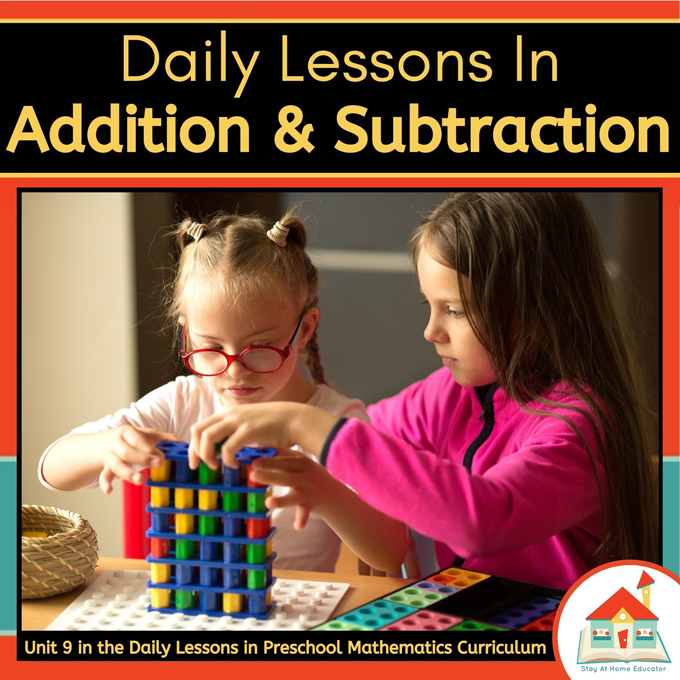
Shop our Counting, Addition & Subtraction Preschool Math Lesson Plans
Help preschoolers master math skills with playful and done-for-you math lesson plans.
Shop our Shapes, Patterns, and Comparing Math Lesson Plans
Find the perfect preschool math lessons for easy, effective teaching.

I’m Sarah, an educator turned stay-at-home-mama of five! I’m the owner and creator of Stay At Home Educator, a website about intentional teaching and purposeful learning in the early childhood years. I’ve taught a range of levels, from preschool to college and a little bit of everything in between. Right now my focus is teaching my children and running a preschool from my home. Credentials include: Bachelors in Art, Masters in Curriculum and Instruction.


