
The Role of Explicit Alphabet Instruction
Most of us want preschoolers to feel confident with letters, but letter recognition can be surprisingly uneven in early childhood. Some children learn letters quickly through exposure, while others need more direct support to remember letter names, connect sounds, and recognize letters in different settings.
That’s where explicit alphabet instruction helps. It’s a clear, step-by-step way to teach letters so children aren’t guessing and they can really solidify alphabet knowledge skills. As a teacher or parents, you’ll still use fun, hands-on activities, but the difference is you’ll be teaching with a plan.
This guide walks you through what explicit alphabet instruction is, why it matters, and a practical daily routine you can use for teaching letter recognition in preschool.
What You’ll Learn
- What “explicit alphabet instruction” means in preschool-friendly terms
- How explicit instruction differs from exposure-only letter learning
- A daily step-by-step routine for teaching letter recognition (that actually sticks)
- How to build cumulative review so kids don’t forget letters you already taught
- Ways to keep explicit teaching playful through centers and hands-on practice
- What to do when children confuse letters or struggle with retention
- Teaching tips that make letter instruction smoother (and faster)
How to Teach Letter Recognition Without the Guesswork
Explicit instruction works best when it’s consistent with the same lesson flow, clear language, and built-in review. Think of it like a simple “script” you can repeat every day so kids know what to expect which saves time in the classroom. If you’re the kind of teacher who loves having a complete routine mapped out for you, the Daily Lessons in Preschool Literacy Curriculum is designed around this exact “explicit + consistent + review” approach.

What is Explicit Alphabet Instruction?
Explicit alphabet instruction is a structured, direct, and purposeful approach to teaching letter recognition and sounds. Unlike incidental learning which happens through casual exposure, explicit instruction provides clear and systematic lessons that guide children toward mastery. It ensures that all children receive the support they need to recognize letters and connect them to their sounds, leading to stronger reading skills.
How Explicit Alphabet Instruction Works
Explicit teaching focuses on three essential components:
- clear modeling (“This is… it says…”)
- guided practice (you practice together)
- repeated review (so learning sticks over time)
Instead of hoping children pick up letters through posters, books, and puzzles alone, explicit instruction ensures every child gets direct teaching and enough repetition to reach automatic recognition.
Key Elements of Explicit Alphabet Instruction
- Clear Goal: Focus on one target letter (or a small review set) so children can master it without feeling overwhelmed.
- Direct Modeling: Clearly state the letter name and sound (and model formation when appropriate). Example: “This is M. M says /m/.”
- Immediate Practice: Children respond right away by saying the name, sound, or forming the letter to strengthen retention.
- Feedback: Provide quick correction and encouragement to reinforce accuracy and build confidence.
- Cumulative Review: Previously taught letters are practiced daily to build automatic recognition and long-term mastery.
Explicit vs. Implicit Alphabet Instruction
When teaching letter recognition, it’s important to understand the difference between explicit alphabet instruction and implicit alphabet learning.
Implicit Alphabet Learning (Exposure-Based)
Implicit learning happens through everyday exposure. Children see letters:
- In books
- On classroom charts
- In puzzles, toys, and sensory bins
- On signs and labels
This kind of exposure builds familiarity and awareness. However, for many preschoolers, exposure alone does not often lead to mastery. Children may recognize a letter sometimes, but without structured practice, recognition is often inconsistent.
Explicit Alphabet Instruction (Direct Teaching)
Explicit instruction is intentional and systematic. Instead of hoping children absorb letters naturally, the teacher clearly teaches one letter at a time, provides guided practice, and revisits it regularly.
Explicit teaching includes:
- Direct explanation of the letter name and sound
- Immediate child response
- Corrective feedback
- Repeated short reviews over time
For example, a teacher might say:
- “This is M. M says /m/.”
- “Watch my mouth: /m/.”
- “Let’s find M.”
- “Now we’ll build M.”
Children respond right away and receive feedback, helping move learning from simple exposure to automatic recognition.
Why the Difference Matters
Both exposure (implicit learning) and direct teaching play important roles in early literacy development. Implicit learning supports explicit instruction by surrounding children with meaningful print, which reinforces and strengthens the letters they have already been directly taught.
However, explicit alphabet instruction provides the essential foundation. It ensures every child receives clear explanations, structured practice, and repeated review to build strong letter–sound connections. When direct teaching is paired with rich exposure, children are far more likely to develop automatic recognition.

A Step-by-Step Routine for Teaching Letter Recognition (Daily Lesson Framework)
Below is a routine you can use as your “daily lesson template.” It mirrors what strong, systematic preschool literacy instruction looks like: review → teach → practice → reinforce → revisit.
Step 1: Review (Cumulative Practice)
Use bulletin board alphabet cards to do the following:
- Point to each letter and say it’s name.
- Have the children echo the name back.
- Say the letter sound and have the children echo is back.
Follow the same procedure again with only the letters that have been previously and formally introduced, but with this change:
- Invite the children to say the picture name on the alphabet card along with the letter name and sound.
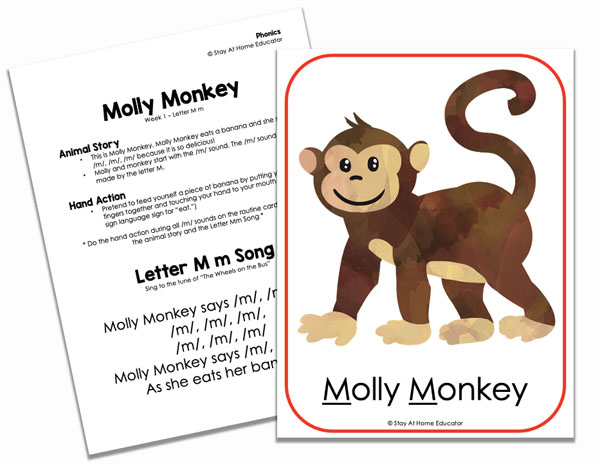
- For example: Teacher: M, /m/. Student: Molly Monkey. /m/, /m/, /m/.
Teaching Tip: Keep review fast. You’re aiming for many correct reps — not a long discussion.
Step 2: Introduce the New Letter (Name + Sound)
Teach one new letter at a time. We introduce one new letter each week, with a review week of all previously introduced letters every four weeks.
- “This is T.”
- “T says /t/.”
- “Say it with me: /t/.”
- connect to a keyword/picture (one strong example is enough)
Teaching Tip: Strengthen this routine by adding a short letter-focus story and a simple hand movement tied to the letter sound. A quick, memorable story gives the sound meaning, while a consistent gesture (for example, rubbing your tummy for /m/) adds a physical cue that boosts memory. When children see it, say it, hear it, and move it, retention improves significantly.
Step 3: Model + “Mouth Check” + Formation (Optional but Helpful)
Preschoolers learn sounds faster when they can see how the sound is made.
- “Watch my mouth: /t/ /t/ /t/.”
- Kids copy your mouth shape.
- Show letter formation with simple language (for children who are ready)
Teaching Tip: Formation can be multisensory without requiring pencil mastery: build with playdough using alphabet playdough mats, trace in sand, write in the air, use a finger on a textured card.
Step 4: Guided Practice (Fast Feedback)
Now children practice with you by participating in a variety of letter recognition activities focused on the specific letter. These activities are things like:
- repeat of the alphabet or letter routine
- practicing onset and rime using phonics photo cards
- letter sorts
- searching for letters in print
- naming words with same beginning sound
- listening letter sorts
Teaching Tip: Use a quick “I Do / We Do / You Do” format to keep instruction clear and effective. This gradual release builds confidence while ensuring active participation and strong retention.
Step 5: Play-Based Reinforcement (Centers + Small Group)
This is where preschool stays preschool. Use hands-on activities to reinforce the same letter goal:
- Beginning Sounds Clip Cards
- Beginning Sounds Picture Seek
- Hands-on Alphabet Worksheets
- Roadway Letter Tracing Mats
- Beginning Sounds Fill-In Cards
Teaching Tip: The magic is alignment: the play activity should clearly connect to the letter you just taught. You can also add in letters that have been previously taught.

Read this: Fun Ways to Teach Letter Recognition (That Actually Work, Too)
Why Is Explicit Alphabet Instruction Important? (What Research Tells Us)
When teaching preschoolers the alphabet, it requires a systematic and explicit approach. It is not just about simple teaching, it should be step-by-step and direct, as this leads to the best learning outcomes. Children learn letters more reliably when instruction is:
- Clear
- Intentional
- Repeated over time
- Supported by guided practice
Here’s why that matters:
1. Foundational Literacy Skills
Letter knowledge is one of the strongest predictors of later reading success. When preschoolers receive explicit instruction in letter names and sounds, they build the phonemic awareness and print knowledge necessary for decoding.
2. Equity in Early Literacy Development
Children enter preschool with vastly different levels of print exposure. Some have been read to daily; others have had minimal structured literacy interaction. Explicit instruction helps close that gap by ensuring every child receives:
- Direct teaching
- Structured review
- Equal access to foundational skills
3. Brain Development and Retention
During the preschool years, the brain is highly receptive to structured repetition and multisensory learning. Research shows that skills strengthen when children:
- Retrieve information repeatedly
- Practice in varied formats
- Receive immediate corrective feedback
See Explicit Alphabet Instruction in Action
Want to know what explicit alphabet instruction actually looks like in a real preschool lesson? Download a free curriculum sample and see the clear routines, scripted language, guided practice, and cumulative review that help children master letter names and sounds.
This sample gives you a practical, step-by-step look at how structured, direct instruction builds strong letter–sound connections and supports reading readiness.
If you’d like this routine already mapped out for you day by day, including what to review, what to teach next, and the kinds of activities that reinforce each lesson, that’s exactly what the Daily Lessons in Preschool Literacy Curriculum is built to do. It follows an explicit, systematic structure so you can stay consistent (even on busy weeks) while children get the repetition they need for real mastery.
Best Practices for Explicit Alphabet Instruction
Effective explicit alphabet instruction isn’t random. It’s built on four core principles: explicit, systematic, frequent, and consistent teaching. When these work together, preschoolers build strong and lasting letter knowledge.
1. Explicit Instruction: Teach with Clarity and Purpose
Explicit instruction means we don’t leave learning to chance.
- Clearly state the letter name and sound.
- Model pronunciation and formation.
- Provide immediate guided practice.
Instead of hoping children “pick it up,” we explicitly introduce it and directly teach it.
Teaching Tip: Use consistent language daily: “This is ___. ___ says ___.” Predictable phrasing reduces confusion and builds confidence.
2. Systematic Instruction: Teach in a Logical Sequence
Letter learning should follow a thoughtful progression.
- Introduce high-utility letters first (m, s, r, t, p, n, a).
- Separate commonly confused letters.
- Build from recognition to sound application.
Most importantly, include cumulative review so previously taught letters don’t disappear.
Teaching Tip: Plan your review set before adding a new letter. Retention depends on repetition.
3. Frequent Instruction: Provide Daily Practice
Preschoolers need short, repeated exposure to letters in order for learning to stick. Letter recognition develops through consistent retrieval, not through random and occasional practice. Daily instruction allows children to:
- Hear the letter name repeatedly
- Practice producing the sound
- Recognize the letter in multiple contexts
- Strengthen memory through repetition
Review letters every day, even if you are introducing a new one. When children see previously taught letters regularly, they retain them more efficiently and build automaticity over time.
Teaching Tip: Plan for 10–15 minutes of focused direct instruction each day, then reinforce those same letters later during centers or small group. When children encounter the same letter multiple times in one day, retention improves dramatically.
4. Consistent Instruction: Use a Predictable Format
Preschoolers don’t master letters through occasional exposure. They need short, intentional, repeated practice built into their daily routine. A strong daily structure might include:
- Cumulative Review (3–5 minutes)
- Quickly revisit previously taught letters. Mix known letters with one that needs extra practice. This daily spiral review strengthens retention and prevents forgetting.
- New Letter Introduction (3–5 minutes)
- Explicitly teach one new letter using consistent language (“This is ___. ___ says ___.”). Keep it focused and clear.
- Guided Practice (3–5 minutes)
- Children identify, say, and interact with the letter while you provide immediate feedback.
- Aligned Center Reinforcement
- Later in the day, literacy centers reinforce the exact letters taught during direct instruction.
- Small Group or Targeted Support (as needed)
- Children who need extra repetition receive short, focused review with just 2–3 letters.
Short daily lessons consistently outperform occasional long lessons because preschoolers retain information through repetition and retrieval — not through length.
Teaching Tip: If children are forgetting letters, increase review frequency before introducing additional new letters. Retention improves when exposure is daily and cumulative.

Read this: 50+ Fun Letter Recognition Activities (At Home or School)
Common Challenges and Solutions
There are real challenges that come with teaching letter recognition — and most have simple, practical fixes.
- Challenge: Students struggling with letter recognition
- Solution: Increase cumulative review and provide more varied practice (matching, hunts, sensory play). If needed, do a short daily 1:1 or small group review with just 2–3 letters.
- Challenge: Maintaining engagement during explicit instruction
- Solution: Keep teaching short and make practice playful: movement, songs, letter scavenger hunts, sensory trays, and quick games. Rotate activities, not the learning goal.
- Challenge: Confusing similar-looking letters (b/d, p/q)
- Solution: Separate these in your sequence, teach them with multisensory formation, and use consistent verbal cues. Increase “find and sort” practice so children see differences repeatedly.
- Challenge: Busy schedules make consistency hard
- Solution: Use a predictable daily routine (review → new letter → practice). Even 8–10 minutes daily plus a quick center activity is enough to maintain progress.
FAQ: Explicit Alphabet Instruction in Preschool
Explicit alphabet instruction is a structured, direct approach to teaching letter names and sounds. Instead of relying on exposure alone, the teacher clearly models the letter, states its sound, provides guided practice, and builds in consistent review. In preschool, this typically includes short daily lessons, cumulative review of previously taught letters, and hands-on reinforcement through centers. This approach helps children develop strong letter recognition skills and prepares them for later phonics instruction and decoding.
Teaching letter recognition explicitly begins with clear and direct modeling. The teacher introduces one letter at a time, states its name, demonstrates its most common sound, and guides children through practice. Previously taught letters are reviewed daily so children retain what they have learned. Practice continues through interactive activities such as matching, identifying letters in context, and multisensory experiences like tracing or building letters. This systematic approach ensures children are not guessing but are developing secure letter–sound knowledge.
Explicit instruction is developmentally appropriate when lessons are short, interactive, and reinforced through play. Preschoolers benefit from clear routines, repetition, and multisensory learning. Explicit teaching does not mean rigid or worksheet-heavy instruction. Instead, it means adults provide clear explanations and structured practice, then reinforce learning through centers, movement, songs, and hands-on activities. When balanced with play, explicit instruction supports confidence and mastery.
Preschoolers benefit from learning letter names and sounds together. When introducing a letter, it is helpful to say both the name and its most common sound. Teaching both simultaneously strengthens letter–sound correspondence and supports future decoding skills. Keeping language simple and consistent helps children make clear connections between the visual symbol and the sound it represents.
Most preschoolers benefit from focusing on one new letter at a time while reviewing previously taught letters daily. Mastery develops through repeated exposure rather than rapid introduction of new material. Moving too quickly can lead to confusion and weak retention. A steady pace combined with consistent cumulative review helps children build automatic recognition.
When a child struggles with letter recognition, increasing the frequency of review is often more effective than introducing additional new letters. Reducing the number of letters practiced at one time can also improve retention. Multisensory activities such as tracing, building, matching, and movement-based learning provide additional pathways for memory. Short, focused small-group instruction can give children the repetition and feedback they need to strengthen letter knowledge.

Build Strong Letter Recognition with a Clear, Daily Plan
Explicit alphabet instruction helps preschoolers develop confident, automatic letter recognition through clear teaching and daily review. When letter names and sounds are introduced intentionally and practiced consistently, children build the foundation they need for future reading success.
Teaching letter recognition in preschool works best with a predictable routine — direct modeling, guided practice, and playful reinforcement — repeated over time.
The Daily Lessons in Preschool Literacy Curriculum is built around this exact structure. Each lesson includes explicit instruction, cumulative review, and aligned hands-on activities so you can stay consistent without second-guessing your sequence.
Shop our Preschool Literacy Curriculum Lesson Plans
Includes everything you need—daily lesson plans, printable centers, and more!
Shop our Preschool Literacy Lesson Plans
Engaging, ready-to-use lesson plans designed for early learners.

I’m Sarah, an educator turned stay-at-home-mama of five! I’m the owner and creator of Stay At Home Educator, a website about intentional teaching and purposeful learning in the early childhood years. I’ve taught a range of levels, from preschool to college and a little bit of everything in between. Right now my focus is teaching my children and running a preschool from my home. Credentials include: Bachelors in Art, Masters in Curriculum and Instruction.


