
Preschool Math Objectives: A Clear Guide for Planning Math
Planning math for preschool can feel overwhelming, especially when you’re trying to figure out what how to organize preschool math skills into a scope and sequence that makes sense. Clear preschool math objectives take the guesswork out of planning by helping you align skills, expectations, and preschool math activities in a way that’s developmentally appropriate and systematic.
What You’ll Learn
- What preschool math objectives are (and why they matter)
- The 5 core math domains taught in preschool
- Specific, developmentally appropriate math skills for preschoolers
- How to turn objectives into play-based math activities
- Common mistakes to avoid when planning preschool math goals
- How to know which skills your preschoolers are ready for
A Simple System for Planning Preschool Math
Instead of piecing together random activities, it helps to use a clear, skill-based framework that shows what to teach and when. When objectives guide your planning, your lessons become more focused and easier to adjust for individual learners. That’s exactly what the Daily Lessons in Preschool Math Curriculum does. It smiplifies teaching by organizing preschool math skills into effective, proven math activities that can be done in short, daily lessons.

What Are Preschool Math Objectives?
Preschool math objectives are clear statements describing the math skills children are working toward. They define what preschoolers should be able to know, understand, and do through hands-on learning experiences. Strong objectives:
- Are developmentally appropriate
- Focus on understanding, not outcomes
- Support play-based and hands-on learning
- Help adults track progress
Rather than rushing academic outcomes, math objectives help you build a strong foundation that prepares children for future learning that is more formal and rigorous.
Read this: Mathematics in Preschool – Playful Learning Activities
What Do Math Objectives Look Like In Preschool?
In preschool, math learning should feel active and natural, with a balance of formal instruction and exploratory based activities. Math objectives are best met when children explore concepts through experiences that feel routine, yet engaging.
Effective preschool math objectives are taught through:
- Songs, stories, and movement
- Games and manipulatives
- Daily routines like snack time, clean-up, and transitions
- A developmentally appropriate preschool math curriculum that builds skills intentionally over time
- Open-ended play with purposeful repetition
At this stage, repetition is essential. Children build understanding by encountering the same skills in many different ways and contexts. The goal of preschool math is building familiarity, confidence, and curiosity, so that children grow up to see math as something they can enjoy.
Preschool Math Concepts
Preschool math concepts aim to introduce young learners to the five mathematical disciplines:
- Number Sense – understanding numbers and quantities
- Geometry – recognizing shapes and spatial relationships
- Algebraic Thinking – sorting, patterns, and relationships
- Measurement – comparing size, length, weight, and quantity
- Graphing – organizing and interpreting simple data
Together, these domains support problem-solving, reasoning, and real-world thinking, which are critical skills children use every day.
Feeling Unsure What Math Skills Your Preschooler Actually Needs?
Knowing about preschool math objectives is helpful, but planning a full preschool math curriculum can still feel overwhelming. With so many skills, activities, and expectations, it’s hard to know what to teach next or whether your child is developmentally ready to move on.
That’s where a clear skills snapshot helps.
Our free curriculum sample breaks preschool math down into simple, observable skills across number sense, geometry, patterns, measurement, and graphing; it’s all written in a tidy yearly scope and sequence in the sample, plus you get a full free week of lessons and printable centers!
If you want a preschool math curriculum that clearly shows you what to teach, when to teach it, and why it matters, having a structured, developmentally appropriate plan makes all the difference. The next step can help you move from guessing to confident, intentional math instruction.
Math Objectives for Preschoolers (by Domain)
Preschool math objectives are about helping children feel comfortable with math while building the basic skills they’ll rely on later. The focus is on curiosity, confidence, and learning through experience.
Number Sense
Number sense, one of the core preschool math objectives, refers to a child’s overall understanding of numbers and how they work. Preschoolers should be able to recognize, count, and compare numbers.
Here are some specific skills that fall under this category:
- Counting one-to-one correspondence
- Sequences quantities up to 10
- Identified numbers up to 20
- Uses manipulatives to add sums to 3
- Uses manipulatives to add sums to 5
- Uses manipulatives to add sums to 10
- Uses manipulatives to subtract differences to 3
- Uses manipulatives to subtract differences to 5
- Uses manipulatives to subtract differences to 10
Teaching Tip: Have your preschoolers use numbers during real routines like snack, clean-up, or lining up instead of only during math time. When numbers are connected to real quantities and everyday decisions, children begin to understand what numbers actually mean—not just how to recite them.
Geometry
This involves understanding shapes, space, and how things fit together. Geometry helps children develop spatial awareness, which is essential for navigating their surroundings and understanding maps.
Here are the specific skills under Geometry:
- Identifies circle
- Identifies square
- Identifies triangle
- Identifies oval
- Identifies rectangle
- Identifies diamond
- Identifies star
- Identifies heart
Teaching Tip: Have your preschoolers explore shapes through building, moving, and play rather than formal instruction. When children touch, stack, rotate, and compare shapes, they develop spatial awareness naturally and begin recognizing shapes in their environment.
Algebraic Thinking
This might sound fancy, but it’s simply about recognizing patterns and relationships. Algebraic thinking helps children develop problem-solving skills and critical thinking, which are essential in all areas of learning.
Below are specific skills for Algebraic Thinking:
- Sorts by color
- Sorts by shape
- Sorts by size
- Sorts by two or more attributes
- Continues an AB pattern
- Continues an ABC pattern
- Continues an ABB pattern
- Identifies location words
- Identifies location words
Teaching Tip: Have your preschoolers sort, match, and create patterns during open-ended play instead of sitting lessons. Repeating patterns with toys, art materials, or movement helps children notice relationships and build early logical thinking without pressure.
Measurement
This is about comparing and quantifying things. Measurement helps children understand size, distance, and capacity, which they’ll use in everyday life and future science experiments.
Here are some specific skills that fall under Measurement:
- Sequences 3 items from smallest to largest
- Sequences 3 items from largest to smallest
- Sequences 3 items from largest to smallest
- Sequences 5 items from smallest to largest
- Sequences 5 items from largest to smallest
- Uses “standard” to measure length and height
- Uses “standard” to measure weight
- Identifies which quantity is more
- Identifies which quantity is less
Teaching Tip: Have your preschoolers compare size, length, and quantity using everyday objects instead of standard tools. Talking about which item is longer, heavier, or holds more during play builds measurement understanding in a concrete, meaningful way.
Graphing
This involves collecting information, organizing it, and making sense of it. Data analysis helps children develop critical thinking skills as they learn to categorize information and draw conclusions.
Here are some specific skills for graphing:
- Reads a graph of two attributes
- Graphs two attributes
- Reads a graph of three or more attributes
- Graphs three or more attributes
Teaching Tip: Have your preschoolers help collect and organize simple information from their daily experiences, such as favorite snacks or shirt colors. Turning real choices into visual graphs helps children see how data represents real life and encourages discussion and reasoning.
How to Use Preschool Math Objectives to Plan Your Curriculum
Instead of starting with activities, start with skills. Preschool math objectives help ensure math experiences are intentional, developmentally appropriate, and meaningful.
- Identify the math objectives your children are ready for based on observation and developmental progress
- Choose playful, hands-on activities that directly support those specific skills
- Observe children during play to understand how they apply math concepts naturally
- Adjust pacing and expectations based on interest, engagement, and readiness
This approach keeps math flexible and responsive while preventing gaps or overload.
Read this: Unlocking Preschool Math Goals
Bringing It All Together With a Clear, Skill-Based Curriculum
Understanding preschool math objectives is only helpful if you have a clear way to keep track of skills and use them to guide your planning. Many teachers understand the goals but still wonder what to teach next, how to support different readiness levels, or whether they’re missing important foundations.
That’s exactly why I created the Daily Lessons in Preschool Math Curriculum. It’s designed to help you see where children are developmentally and connect those observations directly to meaningful, hands-on learning that works!
Instead of guessing or starting from scratch, the curriculum helps you plan math experiences with confidence while keeping learning playful, flexible, and appropriate for preschoolers.

Common Mistakes When Planning Preschool Math Goals
Even with strong intentions, these common mistakes can limit learning and engagement.
- Teaching math skills too formally or too early instead of through play
- Skipping foundational number sense in favor of more advanced concepts
- Relying on worksheets rather than hands-on manipulatives and real experiences
- Teaching all children the same skills at the same pace despite developmental differences
Assessment, observation, and guided planning helps avoid these pitfalls while keeping math fun, but also incredibly effective.
Frequently Asked Questions About Preschool Math Objectives
Preschool math objectives are clear, developmentally appropriate goals that describe the math skills young children are working toward. They guide teachers and parents in knowing what to teach, when to teach it, and how to support learning through play rather than formal instruction.
Preschoolers typically work on number sense, shape recognition, sorting and patterns, measurement, and simple graphing. These skills help children understand quantities, relationships, and problem-solving in ways that support everyday learning and future math success.
Readiness is best determined through observation during play and daily routines. Watching how children count, compare, sort, and solve problems provides clearer insight than age alone and helps ensure math instruction stays developmentally appropriate.
Worksheets are not recommended as a primary method for teaching preschool math. Young children learn math best through hands-on experiences, manipulatives, games, and real-life interactions that allow them to explore concepts in meaningful ways.
Preschool math objectives give structure to planning by helping educators choose activities with purpose. When objectives guide instruction, lessons stay focused, balanced, and flexible, making it easier to meet children where they are without rushing or skipping foundational skills.
While it’s possible to plan independently, a clear, skill-based curriculum can simplify the process by organizing objectives, tracking progress, and connecting observations to intentional activities. This helps reduce guesswork while keeping math playful and developmentally aligned.
Grab our Math Lesson Plans for Preschoolers Bundle
Bundle and save on preschool math lesson plans for the year!
Shop our Shapes, Patterns, and Comparing Math Lesson Plans
Find the perfect preschool math lessons for easy, effective teaching.

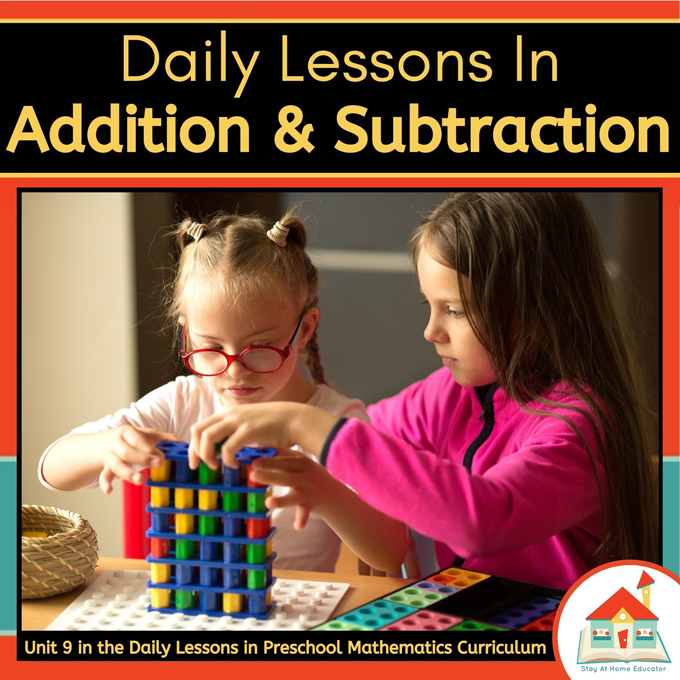
Shop our Counting, Addition & Subtraction Preschool Math Lesson Plans
Help preschoolers master math skills with playful and done-for-you math lesson plans.
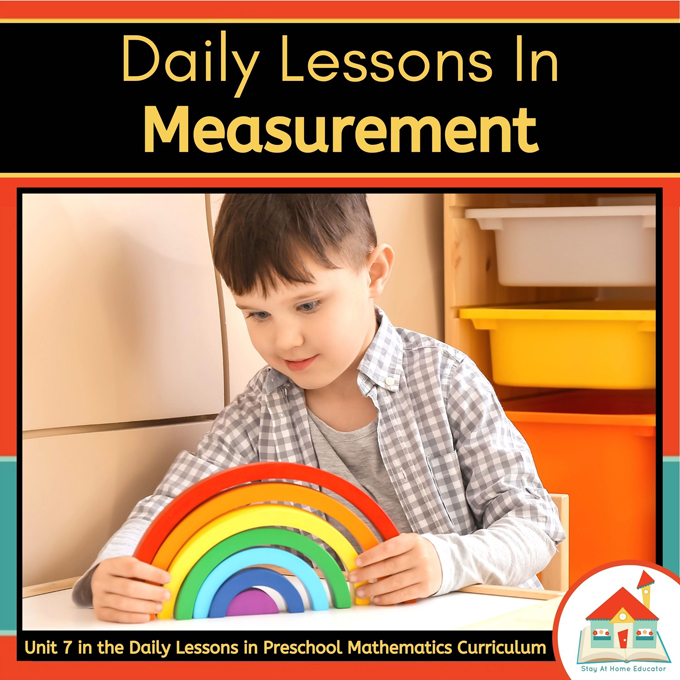
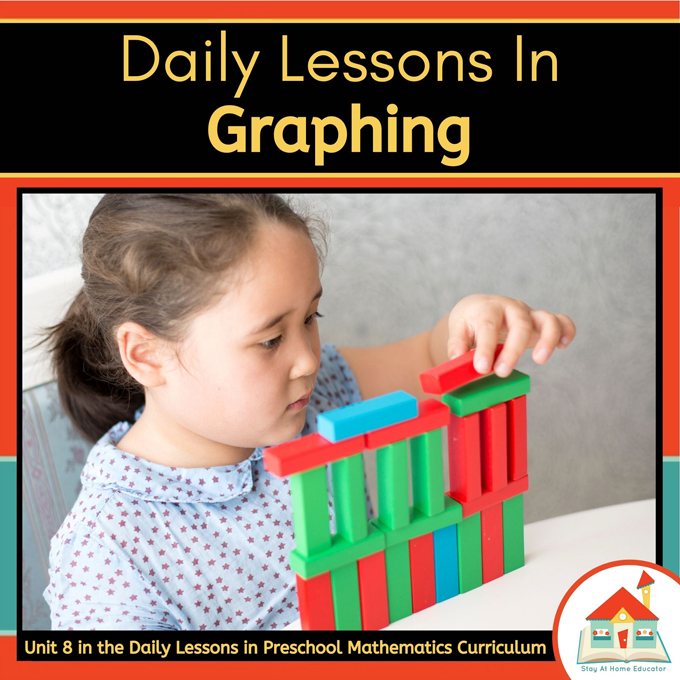
Shop our Measurement, Graphing & Sorting Preschool Lesson Plans
Simplify instruction with ready-to-use lessons on measurement, sorting, and graphing.

I’m Sarah, an educator turned stay-at-home-mama of five! I’m the owner and creator of Stay At Home Educator, a website about intentional teaching and purposeful learning in the early childhood years. I’ve taught a range of levels, from preschool to college and a little bit of everything in between. Right now my focus is teaching my children and running a preschool from my home. Credentials include: Bachelors in Art, Masters in Curriculum and Instruction.
Really helpful article — the way you list objectives like comparing quantities and understanding spatial relationships will definitely guide early childhood educators well.
I can always find something new and for my preschool class to do. This is my favorite go to site for morning work
I’m so glad you are finding great ideas here! Makes my heart happy.