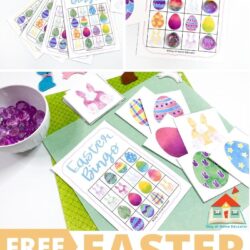
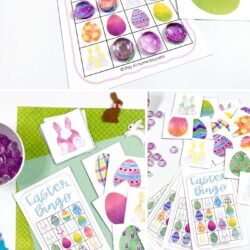
Free Easter Games for Kids: Printable Easter Bingo Game
Seasonal games are a practical way to bring energy and engagement into a preschool classroom or home learning routine. Easter themes naturally introduce bright colors, playful imagery, and simple vocabulary, so what better way to introduce those benefits with free Easter games for kids?
A printable bingo game is especially effective for preschoolers because it combines listening, visual matching, and turn-taking in one activity. The structure is simple enough for toddlers and preschoolers, but flexible enough to support language development, observation skills, and early game play routines.
This free Easter bingo printable provides a ready-to-use game that can be introduced during an Easter theme, used during a spring party, or added to a preschool learning center. Once printed, it requires very little preparation and can be reused throughout the season in a variety of activities.
What You’ll Find Here
- A free Easter bingo printable designed for preschool and early learners
- Clear instructions for setting up and playing the game with young children
- An explanation of the skills children practice while playing bingo
- Ideas for using the printable in multiple ways beyond traditional bingo
- Teaching tips for language development and observation skills
- Suggestions for adjusting the activity for toddlers and older preschoolers
How This Activity Fits Into Early Learning
Simple games play an important role in early childhood classrooms because they combine social interaction with skill practice.
Activities like this are often used alongside seasonal centers and printable activities that reinforce the same concepts. If you are planning a full Easter theme, the Easter Literacy and Math Small Pack offers additional printable centers that build early math, matching, and literacy skills using the same seasonal imagery.
Skills Taught with This Easter Bingo Game
Although bingo is often viewed as a simple game, it supports several important early learning skills.
- Visual Discrimination
- Children must carefully compare the image on the calling card with the images on their game board. This strengthens their ability to notice similarities and differences between pictures.
- Listening and attention
- Players listen for the image that is called and scan their boards to determine whether they have a match. This supports auditory processing and sustained attention.
- Vocabulary development
- Each card introduces familiar spring and Easter images such as eggs, bunnies, and baskets. Discussing the pictures encourages descriptive language and word learning.
- Turn-taking and social skills
- Bingo introduces children to simple group game routines: waiting for their turn, listening to directions, and celebrating a win appropriately.
- Matching skills
- Matching is a foundational cognitive skill that supports both early reading and early math. Bingo strengthens this skill through repeated picture matching.
Why This Skill Matters
Matching and observation skills are foundational for early literacy and math development.
Before children learn to recognize letters and numbers, they must first develop the ability to identify visual differences and similarities. This skill helps them distinguish between similar letters such as b and d, or numbers like 6 and 9.
Games like bingo also help children practice listening for specific information and responding appropriately (kinda’ like phonological and phonemic awareness activities). These listening routines are essential for following classroom directions, participating in group activities, and engaging in structured learning.
Because the activity is game based, children practice these skills repeatedly without needing formal instruction.
When to Use Easter Games for Teaching
This printable Easter game fits naturally into many different learning settings.
- Preschool classroom activities
- Teachers often use bingo during seasonal units or as part of a themed celebration before the holiday.
- Easter parties
- A short bingo game is easy to organize and works well with mixed-age groups of children.
- Learning centers
- Place the bingo boards and calling cards in a small group center for guided play.
- At-home activities
- Parents can use the printable as a quiet afternoon activity or as part of an Easter-themed play day. Teachers can send them home in busy bags for “family homework”.
- Indoor recess or transition time
- Because it requires minimal setup, bingo is also useful when you need a quick group activity.
What Age or Stage This Works Best For
This printable works best for children ages 3–6.
Toddlers (ages 2–3)
Toddlers may not follow full bingo rules yet, but they can still participate in simple matching games using the cards. Invite them to find a picture that matches the calling card.
Younger Preschoolers (ages 3–4)
At this stage, children benefit from simplified rules. Instead of playing until five in a row, try playing until three matches.
Older Preschoolers and Kindergarteners (ages 4–6)
Older children can follow the full bingo format and enjoy the challenge of finding five images in a row.
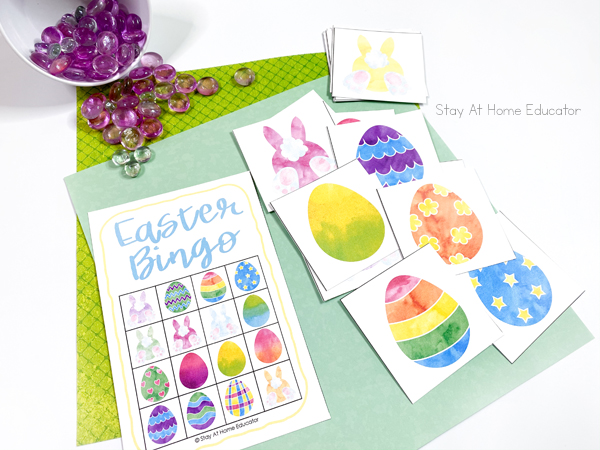
Printable Easter Theme Bingo Game for Preschool
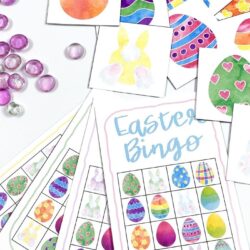
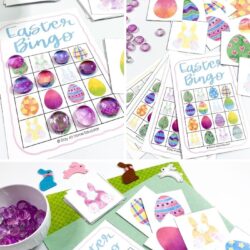
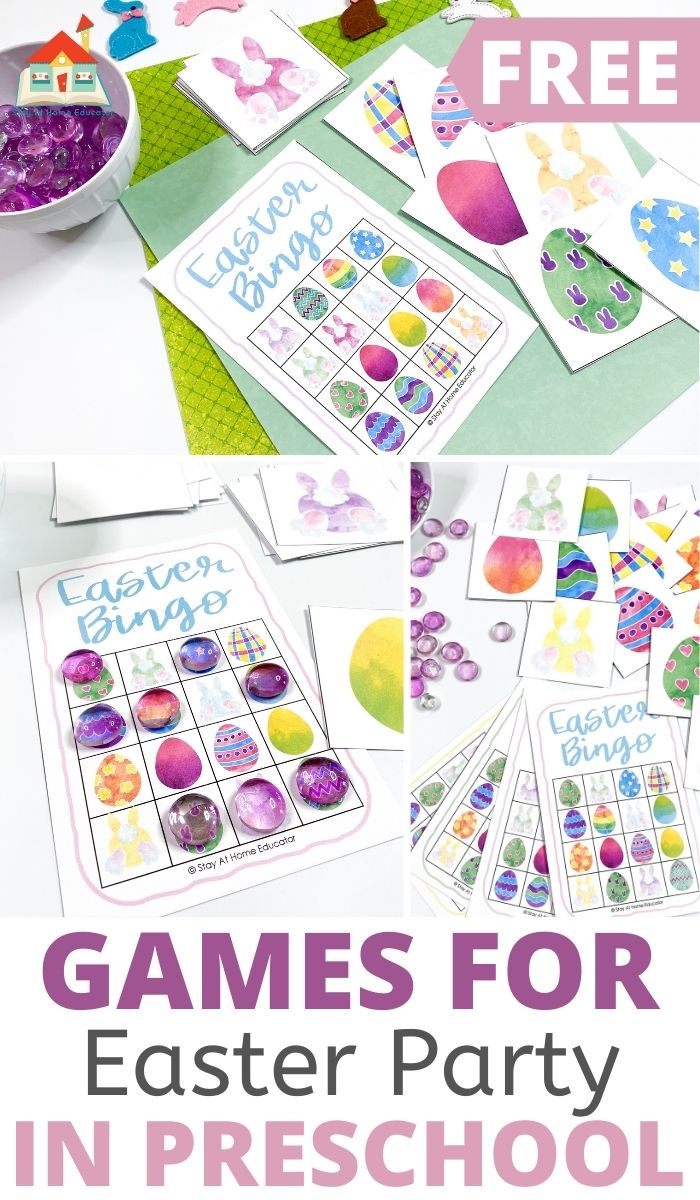
In this Easter bingo game, children listen as a picture card is drawn and then search their own game boards for the matching image. When they find it, they place a counter on the square and continue playing until someone completes a row.
As the game unfolds, preschoolers are practicing several important early learning skills at once. They compare images to find matches, listen carefully for each new card, and scan their boards to locate the correct picture. Along the way, the colorful Easter images encourage children to describe what they see, strengthening observation and vocabulary skills while they play.
What’s Included in the Printable
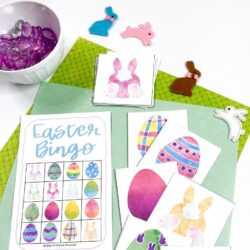
The Easter bingo printable includes the materials needed to run the game easily:
- Multiple Easter-themed bingo boards
- A set of calling cards with matching pictures
- Colorful Easter images such as patterned eggs and cute bunny bums
Materials
You only need a few materials to set up the game.
- Free Easter Bingo printable
- Bingo chips (or math counters)
- Scissors
- Optional: laminator or sheet protectors
Substitution ideas
If you do not have bingo chips available, try using:
- Buttons
- Small pom-poms
- Mini plastic egg halves
- Coins
Setup
Setting up the activity takes just a few minutes.
- Print the Easter bingo boards and calling cards.
- Cut apart the calling cards.
- (Optional) Laminate the boards and cards for durability.
- Give each child one bingo board.
- Provide a small handful of counters or markers.
- Place the calling cards in a bowl or stack to draw from during the game.
Once everything is distributed, children are ready to begin playing.
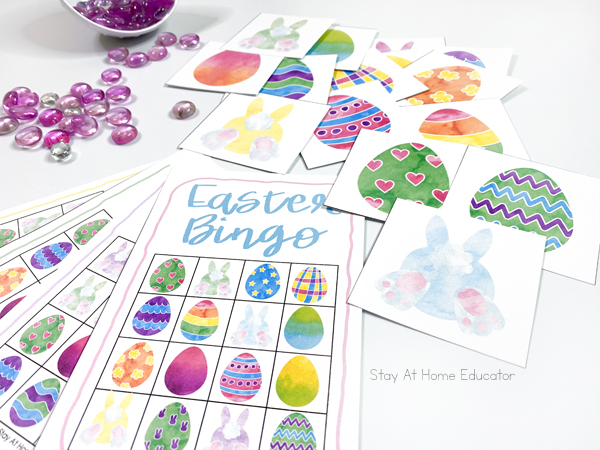
How to Play Easter Bingo with Preschoolers
Once each child has a bingo board and a small pile of counters, the game can begin.
- Place the calling cards in a stack or bowl.
- The teacher or parent draws one card at a time and shows the picture to the group.
- Children look for the matching image on their bingo boards.
- If they find the picture, they place a counter on that square.
- The first player to cover five spaces in a row (across, down, or diagonal) calls out “Bingo!”
After one player wins, clear the boards and start another round. Preschoolers typically enjoy playing several quick rounds in a row.
Get Your Free Easter Bingo Cards
Grab the free Easy Bingo Game and start playing this Easter-themed activity with your preschoolers today.
If you’re planning a full Easter theme, this bingo game pairs well with additional seasonal centers that build early literacy and math skills. The Easter Literacy and Math Small Pack includes ready-to-use printable activities designed for preschool learning. It’s perfect for small groups, centers, or independent practice during your Easter unit.
Teaching Tips for Using Games in the Classroom
Young children often benefit from a bit of guidance during their first few rounds of bingo. Gentle coaching helps them practice observation, listening, and early vocabulary while keeping the activity fun and low-pressure.
Encourage Descriptive Language
Instead of simply announcing the image, invite children to describe what they see. This supports vocabulary development and observational skills. Try prompts like:
- “What do you notice about this egg?”
- “What colors do you see on this one?”
- “Does anyone see something similar on their board?”
- “Who can find the bunny on their board?”
If a child gives a short answer, expand on it:
“Yes, it’s a striped egg! I also see pink and yellow stripes.”
This models richer language without putting pressure on children to respond perfectly.
Model How to Scan the Board
Some preschoolers are still learning how to visually search and compare images. Demonstrate the process by slowly pointing to each picture on your board while thinking out loud:
“Let’s look carefully… I see flowers… a basket… oh! Here’s the bunny!”
This shows children that finding the image is a step-by-step process, not a race.
Celebrate Participation
The goal of early bingo play is skill development, not competition. Recognize behaviors such as:
- Careful listening
- Looking closely at the board
- Helping peers
- Trying again after missing a match
Examples:
- “I like how carefully you’re checking your board.”
- “Great listening — you found it quickly!”
- “Nice job helping your friend look.”
Positive feedback keeps the activity encouraging and inclusive.
Pause Before Revealing the Answer
After showing or describing a card, give children a few seconds to search their boards before placing the counter yourself. This pause:
- Encourages independent thinking
- Gives slower processors time to participate
- Builds confidence in finding matches
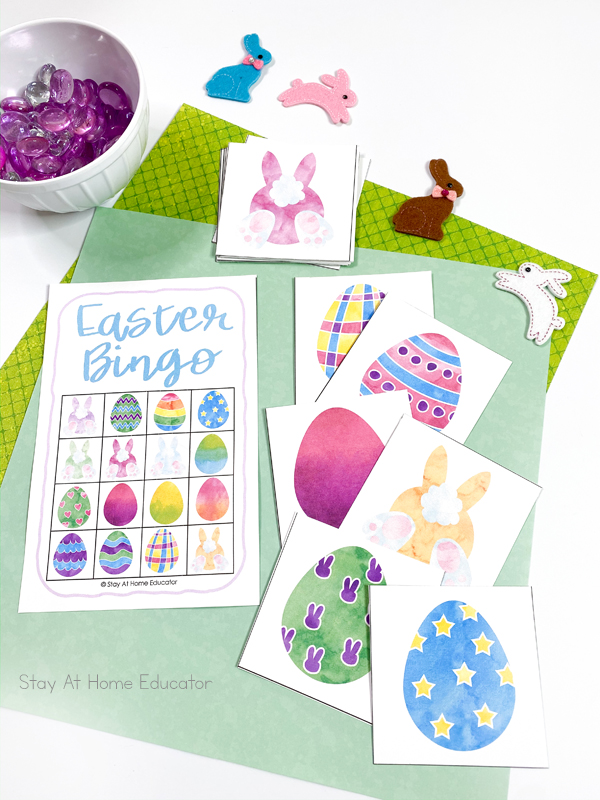
Differentiation Ideas
This printable can be easily adapted to support different learning levels.
Simplify for Younger Children
- Play until three images in a row instead of five.
- Use fewer calling cards at one time.
- Allow children to match images without strict bingo rules.
Add a Vocabulary Challenge
Invite children to describe the picture before placing their counter.
Play a Blackout Game
Instead of getting five in a row, challenge children to cover every square on their board.
Turn It Into a Memory Game
Print two sets of calling cards and place them face down to create a simple matching game.
Related Easter Games and Activities for preschoolers
If your preschoolers enjoy this game, these activities build similar skills.
- Easter Egg Crafts for Preschoolers – Creative crafts encourage fine motor development while reinforcing Easter themes and vocabulary.
- Printable Easter Activities for Preschool Centers – These printable centers provide additional matching, sorting, and counting practice.
- Easter Sensory Bin for Preschoolers – A sensory bin filled with plastic eggs and small themed objects supports exploration and descriptive language.
- Feed the Bunny Easter Counting Activities – A funny matching game of numerals and quantity.
More Ways to Use These in Your Easter Lesson Plans
You know I adore a printable that can be used in more than one way. Here are some other ideas for using this printable.
- Make two copies of the calling cards and play a memory game. For toddlers, play a matching game.
- You can even add the two sets to an Easter sensory bin. Toddlers love finding fun Easter games in their sensory bins with plastic eggs.
- Invite younger preschoolers to describe the pictures they see on their game cards. Have them talk what they see, including the colors and patterns. This is egg-celent for oral language development.
- Use the cards as inspiration to tell and make up stories about the Easter Bunny. As the teacher or parent, you can write down the children’s stories to demonstrate print awareness.
- Challenge the preschoolers to find the differences between two cards. Compare two cards to see what pictures are the same and which pictures are missing.
- Make two copies of each game card. Cut the rows from the second game cards and invite preschoolers to match the cut rows from the second card to the complete game cards.
Get the Free Easy Bingo Game
This printable Easter bingo activity is simple to prepare and works well in classrooms, learning centers, or family celebrations. Once printed, it can be reused throughout the Easter season as a quick and engaging game for young children.
How to Add Easter Themes to Your Preschool Lesson Plans
If you plan to continue your Easter theme beyond a single game, it helps to have a set of activities that reinforce the same skills in different ways. The Easter Literacy and Math Small Pack includes a collection of printable preschool centers designed to practice early learning skills through hands-on seasonal activities. Children work with familiar Easter images while building skills such as counting, matching, pattern recognition, and early literacy.
These activities are especially useful during center time, small group instruction, or independent practice. Because the materials are printable and reusable, teachers and parents can prep them once and use them throughout the Easter season. The activities pair naturally with games like this bingo printable, allowing children to continue practicing visual discrimination, vocabulary, and early math concepts through a variety of engaging tasks.
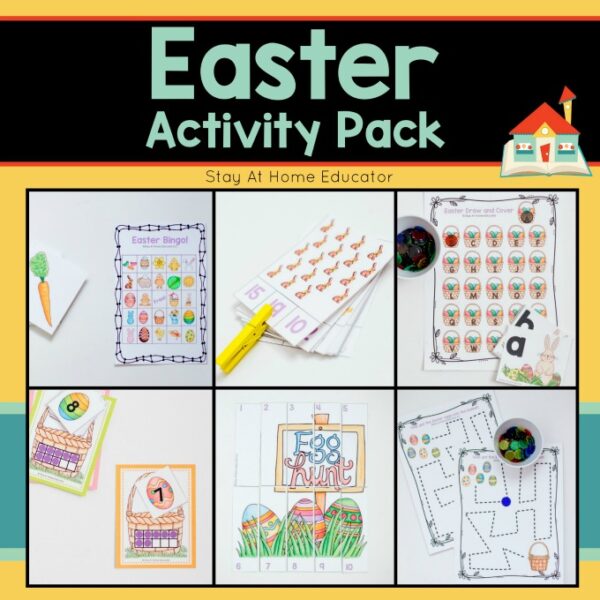
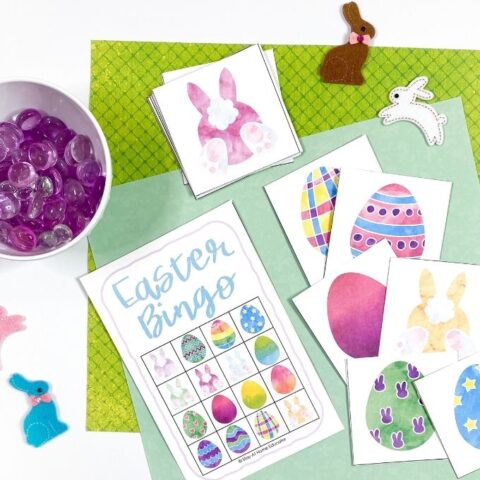
Easter Bingo Game + More Ways to Use This Printable
Of course one of our favorite holiday preschool themes is Easter, and I always like to introduce our this theme with something extra fun like a printable bingo game. Make sure you also print the free bingo game above!
Materials
- heavy cardstock
- counting manipulatives or bingo markers
Tools
- laminator (optional)
- color printer
Instructions
- Print the above bingo game in color on heavy cardstock.
- Cut apart the calling cards.
- Draw a calling card and cover the corresponding picture on your bingo card.
- Continue until a player gets four in a row.
Try these additional ways to use this printable:
- Make two copies of the calling cards and play a memory game.
- Invite younger preschoolers to describe the pictures they see on their game cards. Have them talk what they see, including the colors and patterns.
- Use the cards as inspiration to tell and make up stories about the Easter Bunny. As the teacher or parent, you can write down the children’s stories to demonstrate print awareness.
- Challenge the preschoolers to find the differences between two cards. Compare two cards to see what pictures are the same and which pictures are missing.
- Make two copies of each game card. Cut the rows from the second game cards and invite preschoolers to match the cut rows from the second card to the complete game cards.
Recommended Products
As an Amazon Associate and member of other affiliate programs, I earn from qualifying purchases.
-
 Accent Opaque White 8.5” x 11” Cardstock Paper, 120lb, 325gsm – 150 Sheets (1 Ream) – Premium Smooth Extremely Heavy Cardstock, Printer Paper for Invitations, Cards, Menus, Business Cards – 188179R
 -
 Zasy Foam Filled Wool Felt Carrots Easter Ornament Party Home Decor (9cm Carrot)
 -
 Scotch Thermal Laminator and Pouch Bundle

I’m Sarah, an educator turned stay-at-home-mama of five! I’m the owner and creator of Stay At Home Educator, a website about intentional teaching and purposeful learning in the early childhood years. I’ve taught a range of levels, from preschool to college and a little bit of everything in between. Right now my focus is teaching my children and running a preschool from my home. Credentials include: Bachelors in Art, Masters in Curriculum and Instruction.